
The law puts the floor at 1.6mm of tread across the central three quarters, right the way round, and a floor is not a target. What the law states less tidily is everything else that makes a tyre unfit for use: a bulge, a cut deep enough to reach cord, a chunk torn out of the tread, rubber gone hard and cracked. Every one of those fails a test, and more importantly every one of them can give way while the car is being driven.
Highgate is hard on tyres in ways owners rarely register. Long descents heat them, steep camber and tight turns scrub the shoulders, and parking on a slope means putting a wheel into a kerb far more often than flat streets do. So when something looks wrong the useful thing is a verdict, not a guess. We come out, take the wheel off if that is what it takes, and say which it is: sound, carry on, or finished, and here is the reason. Being told a scuffed tyre is perfectly serviceable is a good outcome, and it happens about as often as the other one.
A car that has been sat unused for months often needs tyres before it needs anything else. We can look at it where it is parked in Fitzroy Park, tell you which of the four are genuinely past it, and fit replacements there without the car making a journey it is not really fit for. An Archway cul-de-sac or a Dartmouth Park main road, tell us which. A tight terrace in Dartmouth Park or a narrow bay on Hampstead Lane is usually workable.
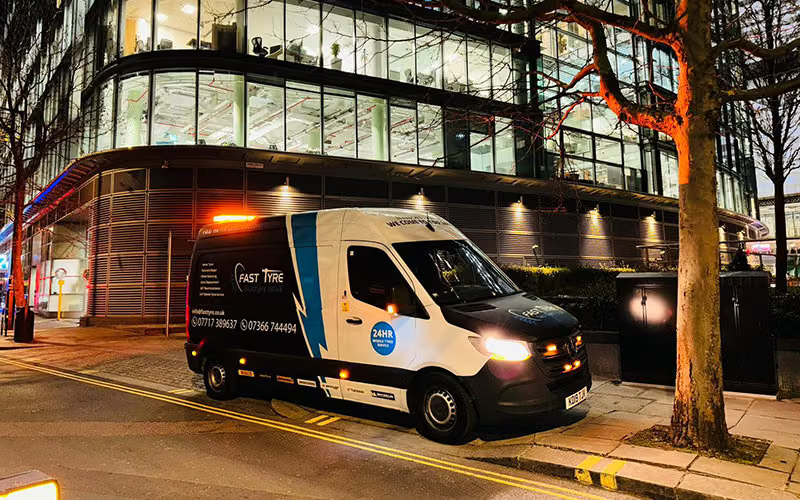
Broken tyre replacement in Highgate is part of our wider mobile 24-hour emergency callout cover. For broken tyre replacement in Highgate, call 07717 389637 or get a price for your tyre.
Steep streets wear tyres in ways flat suburbs never do. Every run down towards Archway is braking, every climb back up to the Village is traction, and parking on those gradients keeps putting wheels into kerbs. A tyre in N6 that has taken a knock is worth a proper inspection, because the failures that matter here tend to happen exactly when the car is working hardest.
The impact snaps cords inside the casing and the swelling shows up hours or days afterwards, which is why drivers only connect the two once somebody explains it. Nothing repairs it. On a car that spends its life climbing and descending Highgate Hill, that is the one to act on at once.
A little-used car in the Village had tread well above the legal minimum and sidewalls covered in fine crazing. Legal on paper, not fit to keep. Rubber ages whether or not the wheels turn, and once a set has dried out it has lost the flexibility that holds it together.
Parallel parking on a gradient sends the front wheel into the kerb harder than the driver intends. On one car near Highgate Cemetery the alloy was scarred and the tyre carried a gouge across the shoulder deep enough to show cord. That tyre was changed. The other three were untouched and stayed on.
Run a hand across it. A scuff is flat, a bulge stands proud of the sidewall and feels soft under the fingers. If it stands proud, stop using the car for anything beyond a slow crawl to a safe parking spot, then ring.
It counts for a lot. Rubber hardens and cracks with time and weather no matter how few miles it has done, and a hardened tyre loses wet grip long before the tread runs out. Anything that has been on the car for years deserves a look.
It is, once the damage reaches the cords, and it is below 1.6mm across the central three quarters. Legality aside, a compromised tyre is at its weakest under braking, which on these gradients is exactly when you are relying on it.
It can shove the alignment out, and sometimes it bends the rim enough to leak at the bead. Both become obvious once the wheel is off, and you hear what we can actually see rather than a vague warning to get things checked.
Then it is fine and that is the end of the matter. Nothing gets changed without your say-so, and the price of any work is settled with you before it begins.
★★★★★ 4.9 from 151 verified Google reviews.
Read all 151 reviews on Google →Prefer a callback? Send your details for a broken tyre replacement price in Highgate.