
Most drivers check a tyre by looking at the tread and nothing else. That habit is built around wear, and wear is only one of the ways rubber stops being fit to use. The other is age. Rubber gives off the oils that keep it flexible whether the car moves or not, and what is left behind goes hard and splits. It shows as fine cracking in the grooves between the tread blocks and along the curve of the wall.
Cars that sit for weeks are the ones this catches, and the Victorian terraces around Bushwood and Cann Hall hold a lot of them. A tyre can be holding air, look clean, measure well above the 1.6mm legal minimum across the central three quarters, and still be finished. On a call like this we get down with a light and open the cracks with a thumb. If they stop at the surface, the tyre has life left in it and you get told so. If the cords show at the bottom of a crack, the casing is no longer sealed against water, and no amount of tread will argue it back.
Kerbs and potholes do most of the damage in E11, and they rarely do it while you are looking. You find it later: a scuff that has gone through to the cords, a split along the shoulder, a lump in the sidewall that was not there last week. You do not drive it anywhere first, and nothing gets towed off Ruckholt Road. A Green Man cul-de-sac or a Bushwood main road, tell us which. A tight terrace in Whipps Cross or a narrow bay on M11 link road is usually workable.
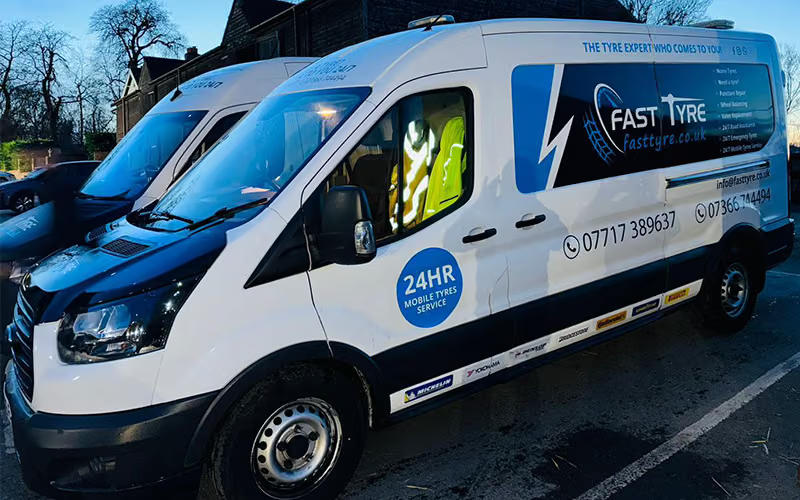
Broken tyre replacement in Leytonstone is part of our wider 24-hour emergency callout across London and the home counties cover. For broken tyre replacement in Leytonstone, call 07717 389637 or get a price for your tyre.
Tyres age faster on the exposed side of a car parked in the same spot all year, and E11 has plenty of that, with residents nose in to the same stretch of terrace week after week. Sun on one wall, damp on the other, and a car that hardly turns a wheel between Sundays. Worth a proper look before a long run rather than after one.
A second car near Wallwood spent most of the year parked. Tread looked close to new. The sidewalls had gone grey and crazed the whole way round, and the date codes put them well past ten years old. Both fronts came off and the rears were flagged to watch.
An owner off Leytonstone High Road had been told elsewhere that all four needed doing. Under a light the crazing sat in the top surface of the rubber and went no further than that. Nothing was sold that afternoon, and those tyres are still on the car.
A driver near Whipps Cross wanted the full size spare checked before a long trip. It had never been used and it had never been looked at either. The rubber had hardened and split around the bead area, so it would have failed the moment it took load.
There is no single legal age, so condition decides it, read alongside the date code stamped on the wall. Once cracking reaches the cords, or the rubber has gone hard and grey right round, the number of years stops mattering and the answer is the same.
It is easier on the tread and harder on everything else. Standing loads flat spot the contact patch, the oils in the rubber leave anyway, and damp sits in the same crack for months. Mileage is not what kills most of the tyres replaced round here.
No. There is nothing to bond to and nothing to fill. Cracking is the rubber itself breaking down, so any product applied to the outside is cosmetic and lasts about as long as the shine. A new casing is the only honest option.
Rarely, though a clear photograph of the sidewall in daylight is a good start, and it tells us what size to bring in case the answer turns out to be a replacement. The verdict itself is given at the car, with the wheel in front of you.
Usually they are close, because they went on together and stood in the same weather. That does not automatically make it four. Each one gets looked at, the date codes get read, and only the ones that have actually gone are changed.
★★★★★ 4.9 from 151 verified Google reviews.
Read all 151 reviews on Google →Prefer a callback? Send your details for a broken tyre replacement price in Leytonstone.