
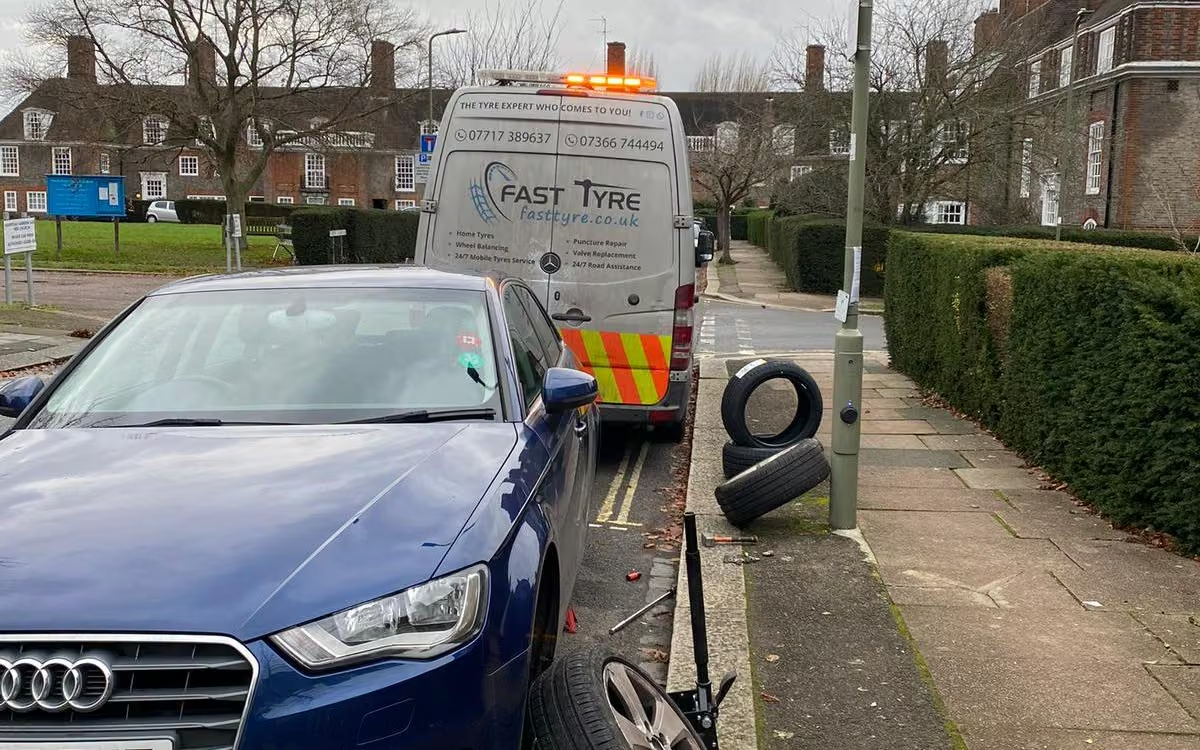
24-Hour Tyre Callout in Elephant and Castle
Every tyre sold carries a label with three ratings on it, and the third one is the one nobody reads.
Mobile 24-hour tyre callout across Elephant and Castle
That gap explains a call we take fairly often at about four in the morning. The roundabout is empty, the traffic that normally drowns everything out has gone home, and a driver suddenly notices a hum that has been there for months. Nine times out of ten it is the tread pattern doing exactly what it was designed to do, more obvious now than at any other hour. What is worth ringing about is noise that is tied to the wheel rather than to the speed: a slap or a rhythmic beat that quickens as you accelerate and can be counted. That is something in the tread, or a tyre that is no longer round, and it is worth a look while the road is quiet enough to hear it.
Christmas Day, New Year, Easter Monday: the days when absolutely nothing is open are the days a tyre picks. It runs 365 days a year across Greater London, bank holidays included, at whatever hour the call comes in. Old tyres leave the London Road area, New Kent Road and SE1 with us, every time. You watch it happen in Elephant and Castle, or at the kerb in Walworth. The SE1 postcode and a street in Newington: that is enough.

What you get with our 24-hour tyre callout in Elephant and Castle
- 2am on the A201 (Newington Causeway) or Walworth Road is dispatched like any daytime job
- Saturday, Sunday and bank holiday callouts are routine
- Whether the call comes from Heygate area or New Kent Road, valves and TPMS are covered too
- Nothing is ordered in; the tyre arrives with the fitter
- Every Elephant and Castle callout comes with a live arrival time
- SUVs and 4x4s as readily as cars, right across Greater London
24-hour tyre callout in Elephant and Castle is part of our wider mobile 24-hour emergency callout cover. For 24-hour tyre callout in Elephant and Castle, call 07717 389637 or send us your details for a price.
Local knowledge across Elephant and Castle
This is one of the loudest junctions in inner south London for about twenty hours a day, and the constant traffic on New Kent Road and London Road masks anything your own car is doing. Then the roads empty out, and everything you have not been able to hear since the spring arrives at once. It is a good moment to listen properly. A steady hum that tracks your speed is normal. A beat that keeps time with the wheel is not, and it deserves somebody taking the wheel off.
24-Hour Tyre Callout call-outs we handle in Elephant and Castle
Only loud when it was quiet
A driver on an empty stretch of the A201 at four in the morning was convinced something had failed. The tyres were fine and had been humming quietly for a year with the daytime traffic covering it.
A beat you could count
Another car had a slap that repeated in step with the wheel rather than rising smoothly with road speed. There was a flint driven into the tread, and it was audible precisely because nothing else was moving.
Same size, different class
Two options in one size, one rated a class quieter than the other. The driver chose on the label, which is what the label is there for, and the difference was audible on the first night run.
What Elephant and Castle drivers say about our 24-hour tyre callout
★★★★★ 4.9 · based on 155 Google reviews
Super fast and efficient service. Came out and fixed my tyre on the spot, even though it was late. Fair price.
Google review
I clipped the kerb when parking, damaging the wall of my tyre. I contacted Fast Tyre at 21:37 and by 23:40 I had a new tyre fitted. Excellent service and both boys were friendly and efficient.
Google review
5 star without a doubt! Called this morning with a complete flat tyre in N13 and within 30 minutes Abdul arrived and changed it. He also checked all 4 tyres and showed me one was completely bald and dangerous to drive.
Google review
24-Hour Tyre Callout in Elephant and Castle, FAQs
It is the external rolling noise the tyre makes, measured in decibels and shown as a class. It is a pass by measurement, so it is genuinely comparable between tyres, but it describes what a bystander hears rather than the noise inside your car.
It often does. As tread blocks wear down they get stiffer and noisier, and uneven wear makes it worse still, because the blocks are no longer meeting the road evenly. A tyre that has become noticeably louder over a few months is worth measuring rather than ignoring.
Tyre noise generally rises and falls with road speed and changes with the road surface. A bearing tends to whine or growl and often changes when you steer gently one way and then the other, because the load moves from side to side. If it alters on a curve, suspect the bearing.
Yes, and we would rather do that than have somebody drive on something that turns out to be a stone through the tread. We work 24 hours a day, every day of the year, and the small hours are usually our quickest response of the lot.
24-Hour Tyre Callout in Elephant and Castle, 24/7
Prefer a callback? Send your details for a 24-hour tyre callout price in Elephant and Castle.