
Burst Tyre Replacement in Clapham
It takes about a fortnight for the habit to set.
Mobile burst tyre replacement across Clapham
What happens inside the tyre during that fortnight is not neutral. A tyre running under pressure carries its load on the sidewalls instead of the tread, and a sidewall flexing beyond its design deflection makes heat faster than the casing can shed it. Heat is what breaks the bond between rubber and steel cord. Once that bond begins to fail the plies separate, and a separated casing does not weep or hiss to warn you. It bursts, at whatever speed you happen to be doing when it finally goes.
That is the ugly part of the arithmetic. On day one it was a screw in the tread and a repair. On day fourteen it is a new tyre, with a frightening minute on a fast road thrown in beforehand.
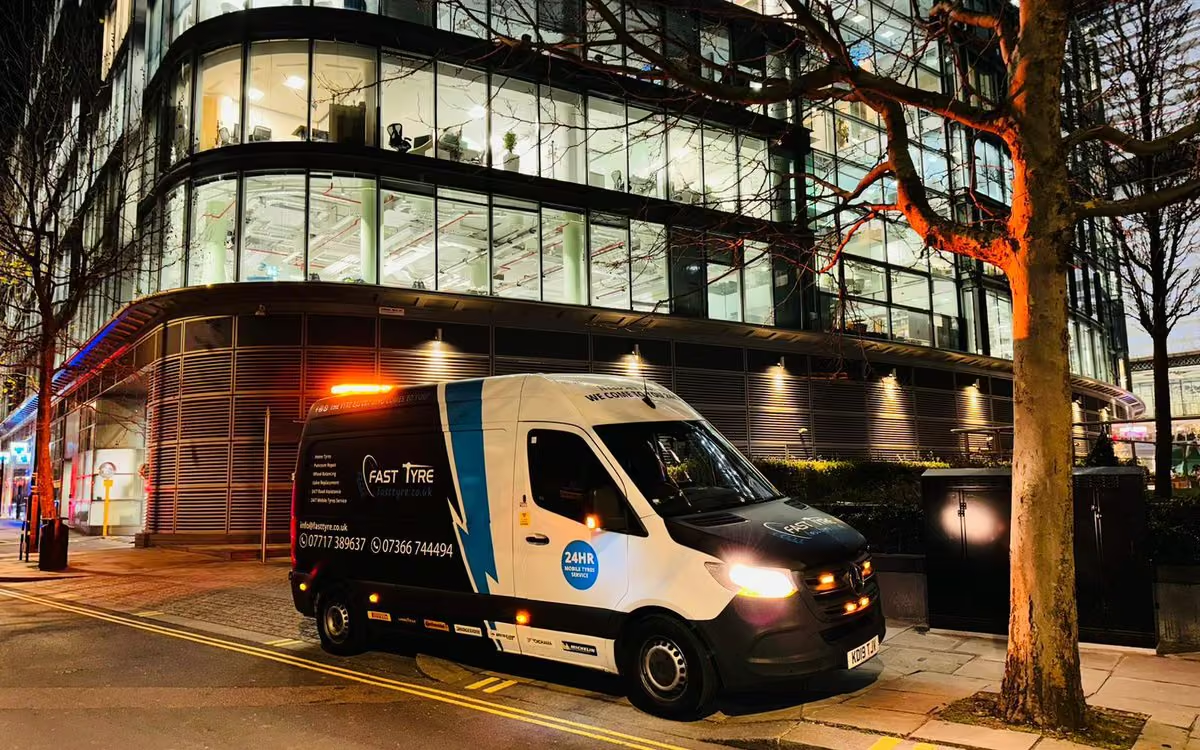
The bang is the least useful part. One call sends a fully-equipped technician to where you actually are in SW4, with a replacement on board and a live ETA from the moment the van leaves. Pressures set before we leave Abbeville Village, and the same on Kings Avenue. The wheel comes off in Abbeville Village, not on a ramp in Balham. The SW4 postcode and a street in Abbeville Village: that is enough.

What you get with our burst tyre replacement in Clapham
- A blowout on the A3 (Clapham Common South Side) gets a fast roadside response
- One visit rather than two
- Roadside and hard-shoulder fitting here as in Wandsworth and Brixton
- Family cars, SUVs and 4x4s, on one number
- You know when we will reach Abbeville Village, not just that we are coming
- Every hour of every day, all year
Burst tyre replacement in Clapham is part of our wider 24-hour emergency callout cover. For burst tyre replacement in Clapham, call 07717 389637 or ask us for a quote.
Local knowledge across Clapham
Driving here hides this fault better than most places. Short runs to the shops, a crawl along the High Street, nothing much above thirty for days on end: none of it asks enough of a tyre to expose what is going on inside. The first proper stretch of speed is often the run out on the A3.
Burst Tyre Replacement call-outs we handle in Clapham
Two weeks of topping up
The driver had been putting air in every few days since a screw went in. When the tyre came off the rim, the liner was blistered and grey where it had been running hot. The screw was still sitting there, in perfectly repairable territory.
Failed on the A3 by the Common
A car that had been fine around town for a fortnight lost its nearside front on the A3 by Clapham Common, which was the first stretch it had done at any real speed all week. Local mileage hides an underinflated tyre completely.
The pressure warning that was ignored
A dashboard light had been on since the start of the month and had been read as a sensor fault. It was not. The tyre was down by a quarter and had cooked the inside of its own shoulder, so no repair was ever going to be possible.
What Clapham drivers say about our burst tyre replacement
★★★★★ 4.9 · based on 155 Google reviews
Absolutely amazing service. They turned up promptly and got the wheel changed within 20 minutes. The pricing was also very reasonable and transparent.
Google review
Just been helped by Abdul. The best customer service experience ever. He went far above and beyond what we expected. An example for everyone to follow.
Google review
Abdul was super quick getting to me, literally within 30 minutes, and super quick sorting my car out. Very polite and checked I was OK. Highly recommend.
Google review
Burst Tyre Replacement in Clapham, FAQs
As a rule, if you can see that it is down, it is down enough to be doing harm. Sidewall flex rises steeply once a tyre has lost much of its pressure, and the damage accumulates rather than resetting when you add air.
It is less alarming, not less serious. A slow leak means the tyre spends most of its life underinflated and is brought up to full for an hour or two at a time. That is a worse life for a casing than one sudden puncture dealt with at once.
Yes, easily. The inner liner shows it. Scuffing, a dull grey rubber dust, blistering, sometimes the liner lifting away in strips. That evidence is why a tyre gets condemned, and you are welcome to look at it before anything goes in the back of the van.
Fault is not really the point, but the sequence is worth knowing so the next one goes differently. Most burst tyres we cut open were not attacked by the road. They were slowly destroyed by being run soft, and every one was repairable at the start.
Burst Tyre Replacement in Clapham, 24/7
Prefer a callback? Send your details for a burst tyre replacement price in Clapham.