
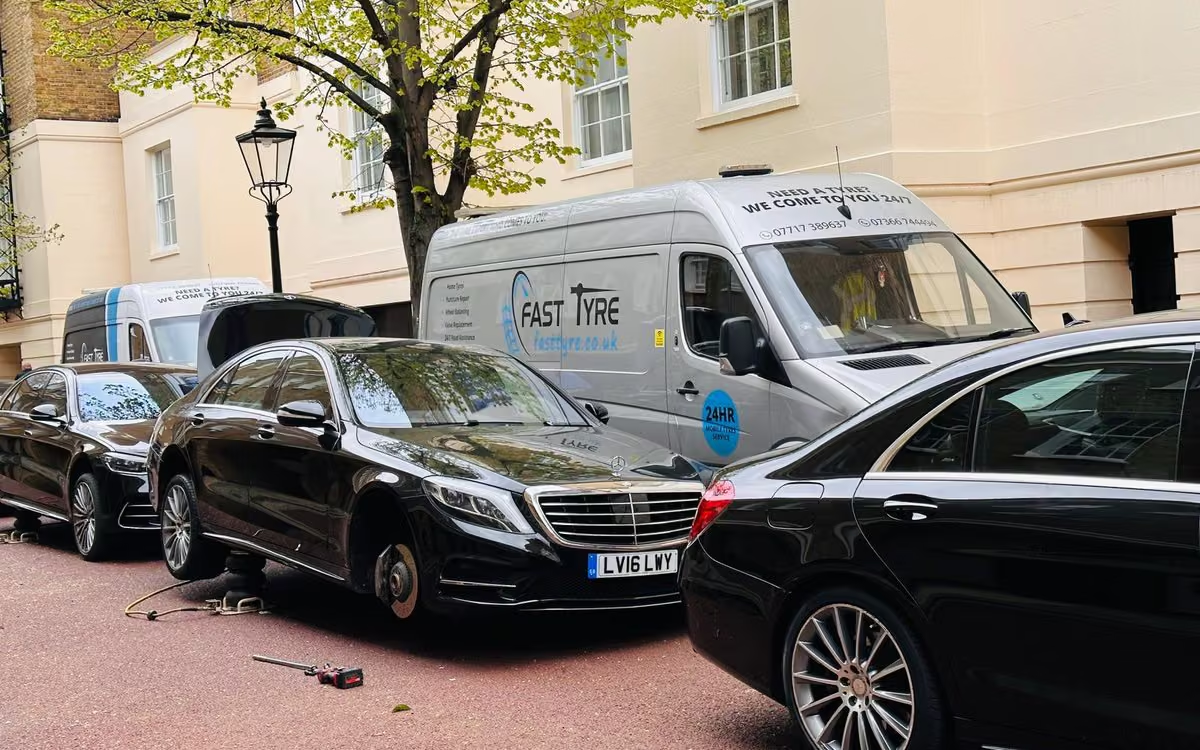
Burst Tyre Replacement in Richmond
Pull a flint out of a tread groove and you can usually tell how long it has been living there.
Mobile burst tyre replacement across Richmond
That is how a fair number of blowouts are actually made. Nothing punctures on the day. The stone, or the glass chip, reaches the steel belt underneath the tread, water follows it down, and the steel rusts where no inspection will ever see it. Rusted belt edges lose their bond with the rubber around them, and a tyre with a belt separating inside it runs on a fault that grows every mile.
When that finally lets go it lets go all at once, at whatever speed you happen to be doing. A casing is under no obligation to warn you first. Which is the honest reason we look properly at what is stuck in a tread rather than flicking it out and saying nothing.
With children or an older passenger in the car, waiting is the problem, not the tyre. One call and a technician is on the way to the exact spot in TW9, with the replacement already loaded, and you know when he will be there rather than hoping. Steep camber in Kew? We move a few metres, North Sheen or anywhere else. Blocked drive in North Sheen? Open kerb in Petersham? Either works.

What you get with our burst tyre replacement in Richmond
- Fast response to blowouts
- No supplier wait anywhere in Greater London
- Roadside and hard-shoulder fitting here as in Kingston upon Thames and Mortlake
- Car, SUV or 4x4, in Richmond Hill or Richmond town centre or anywhere near
- You are given a time, and it updates as we travel
- Available 24 hours a day, 365 days a year
Burst tyre replacement in Richmond is part of our wider 24-hour emergency callout cover. For burst tyre replacement in Richmond, call 07717 389637 or ask us for a quote.
Local knowledge across Richmond
Debris is not spread evenly across a road. It gathers in the gutter and the nearside lane of a fast route like the A316, and it gets ground down and scattered on the descent off Richmond Hill where everything brakes hard. Cars living around North Sheen, or out towards Mortlake, collect more than their share, and the pieces that matter are the small sharp ones.
Burst Tyre Replacement call-outs we handle in Richmond
Stones that are not simply stones
Anything wedged tight in a groove has been forced there. A loose stone drops out on its own within a mile or two, so the ones still in place after weeks are the ones that have made room for themselves in the rubber underneath.
A separation does not always bulge
Belt coming away from rubber sometimes shows as a lump and sometimes as nothing more than a faint waviness across the tread, or a rumble at low speed that everybody blames on the road surface. Once found it is a replacement.
Where the debris collects
Fast dual carriageway keeps its rubbish in the nearside lane and the gutter, which is exactly where most cars spend their time. A driver near Lower Mortlake Road had two pieces of sharp aggregate bedded into one rear tyre. Neither had leaked.
What Richmond drivers say about our burst tyre replacement
★★★★★ 4.9 · based on 155 Google reviews
Abdul came and helped me as I was stuck on the side of the road. He came very quickly and was so friendly and helpful. Would highly recommend, great service.
Google review
Very quick call out and replace time, very good price and very polite.
Google review
Excellent service. I am really impressed. Came within 20 minutes or so, put a new tyre on and balanced it.
Google review
Burst Tyre Replacement in Richmond, FAQs
Usually, and most get picked out and forgotten about. The ones that matter are sharp, wedged and deep enough to have reached the belt. That is a judgement made with the stone out and a light on the hole it leaves behind.
Sometimes a hum that changes with speed, sometimes nothing whatsoever. That is the awkward part. A belt separation is a fault inside the casing, and the outside of the tyre can look entirely presentable right up until it fails.
No. Repairs are for a clean hole through sound rubber in the middle of the tread. Corrosion in the steel is structural damage spreading sideways under the surface, and there is no patch made that does anything about it.
A minute a month is plenty. Do it when the tyre is warm and the grooves are open, and run a thumb along each one picking out anything hard. What you are hunting is the thing that has stopped moving.
Burst Tyre Replacement in Richmond, 24/7
Prefer a callback? Send your details for a burst tyre replacement price in Richmond.