

Locking Wheel Nut Removal in Streatham
Half of this job is waiting. Penetrating fluid is not a spray that dissolves rust the moment it lands.
Mobile locking wheel nut removal across Streatham
It creeps down the thread by capillary action and it wants a quarter of an hour to get there. So you soak the nut, walk away, come back and soak it again. Anybody who sprays and reaches straight for the breaker bar has wasted the tin, and on a badly corroded nut the breaker bar is how studs get snapped off in the hub.
The other half is shock instead of force. Steady leverage loads the whole stud evenly, and a stud loaded evenly enough will stretch and then part. A sharp blow through the socket, or an impact wrench hammering rather than pulling, sends a jolt through the threads that cracks the corrosion without ever putting that load on the stud. It is why something that beat two people with a scaffold bar comes apart quietly with the right tool. On the packed streets off Mitcham Lane there is no room to swing anything anyway, which suits the method: the tools that work here are short ones.
Rounded, rusted, over-tightened, or the key is in a drawer somebody moved: the reasons vary and the outcome does not. A locking nut that will not turn stops a tyre change dead. This is a job for the right extraction tools rather than more force, which is why we carry them, and why the alloy comes out of it unmarked. We do it where the car is parked rather than dragging it anywhere, whether that is Streatham Common, Streatham town centre or wherever you have stopped, then get on with the tyre itself. A standard or replacement nut afterwards means the next puncture is only a puncture.
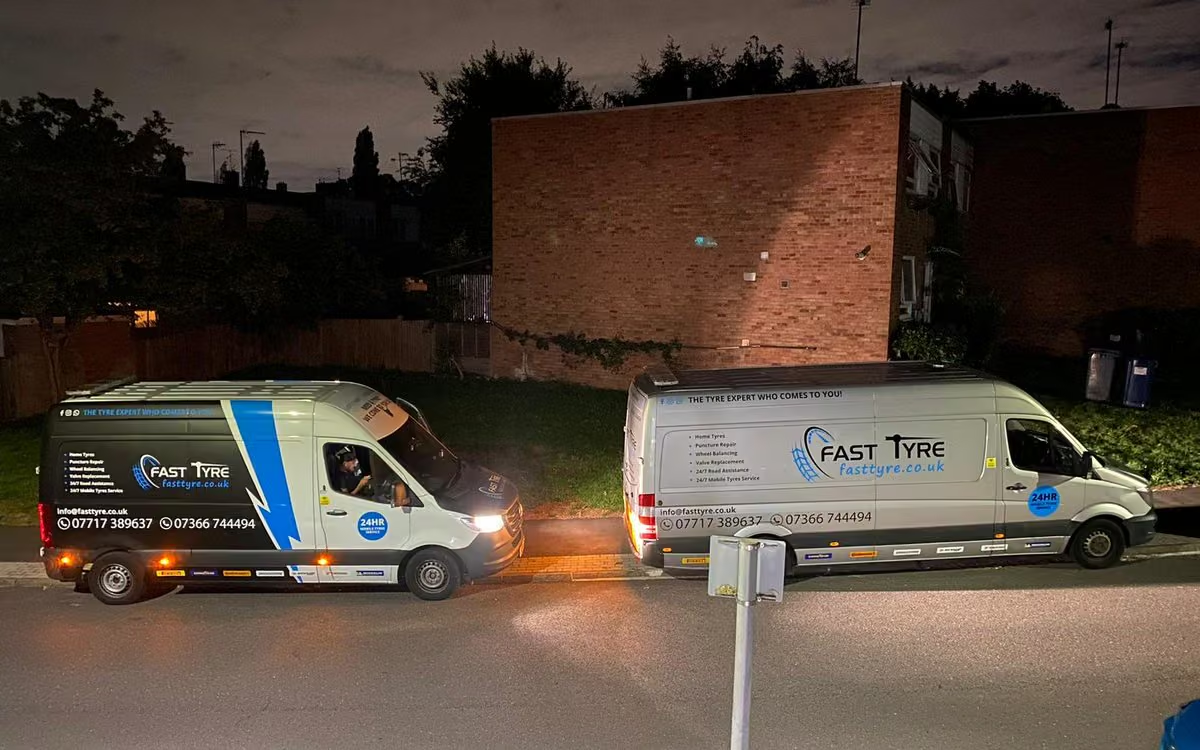
What you get with our locking wheel nut removal in Streatham
- Seized, rusted or rounded nuts, removed on the drive in Streatham Hill
- The key being lost or broken does not stop the job
- Working at a kerb near the A214 (Tooting Bec Gardens) or the A216, the alloy is still shielded
- You leave with a nut that will undo next time
- We come to you, roadside, home or workplace
- Cars, SUVs and 4x4s, here and over in Balham and Tooting
Locking wheel nut removal in Streatham is part of our wider tyres fitted at home cover. For locking wheel nut removal in Streatham, call 07717 389637 or ask us for a quote.
Local knowledge across Streatham
Street parking in SW16 is the whole reason we get these calls. A car that lives at the kerb all year takes road salt, standing water and spray thrown up off the High Road, and it sits in that until something needs the wheel off. Add a set of alloys and you get corrosion between two different metals, which is the version that grips hardest. Very few of these cars have a driveway to dry out on.
Typical locking wheel nut removal jobs in Streatham
Fifteen minutes of doing nothing
We arrived at a nut two people had already fought. The fluid went on, we left it alone, went back to it twice more, and it wound out on the third attempt without a mark on the wheel.
Never off since the car was new
Cars kept on the street all year grow a ring of corrosion between the nut and the alloy. On one in Streatham Vale the wheels had not moved in years, and it was the soaking and a few sharp shocks that broke the seal.
The garage that gave up
A driver was told their usual place could not shift it and to try somewhere else. We went to the car where it sat, worked it loose over about twenty minutes and left an ordinary nut on that corner.
What our customers say
★★★★★ 4.9 · based on 155 Google reviews
I clipped the kerb when parking, damaging the wall of my tyre. I contacted Fast Tyre at 21:37 and by 23:40 I had a new tyre fitted. Excellent service and both boys were friendly and efficient.
Google review
5 star without a doubt! Called this morning with a complete flat tyre in N13 and within 30 minutes Abdul arrived and changed it. He also checked all 4 tyres and showed me one was completely bald and dangerous to drive.
Google review
Honestly wish I could give more than 5 stars! Last night after leaving Wembley we got a flat tyre, stranded 2 hours from home, and these guys got us back up and running. 10/10 service from start to finish, even at 1am!
Google review
Locking Wheel Nut Removal in Streatham, FAQs
Allow half an hour for a bad one, and most of that is the fluid doing its work while nothing appears to be happening. A nut that has only rounded rather than seized is quicker, because there is nothing to soak, only something to grip.
Yes, and most of this work happens exactly there. The car stays in its bay, we work from the road side of it, and nothing needs jacking any higher than it would be for a normal wheel change.
Close to it. A nut that has sat at the kerb in SW16 through a few winters is often corroded onto the stud, so the key is not the problem. It wants penetrating fluid, time and a sharp blow rather than steady leverage, which is how a stud survives the job.
You can, and sometimes it works. Give it real time between attempts rather than thirty seconds. What loses people the nut is going at it hard with an ill fitting socket, because once the shoulders are rounded off there is nothing left for anything to hold.
It goes back on with a torque wrench to the figure the manufacturer set for that car, which is a number rather than an opinion. Nuts done up by feel are how the next person ends up in the same position as you.
Locking Wheel Nut Removal in Streatham, 24/7
Prefer a callback? Send your details for a locking wheel nut removal price in Streatham.