
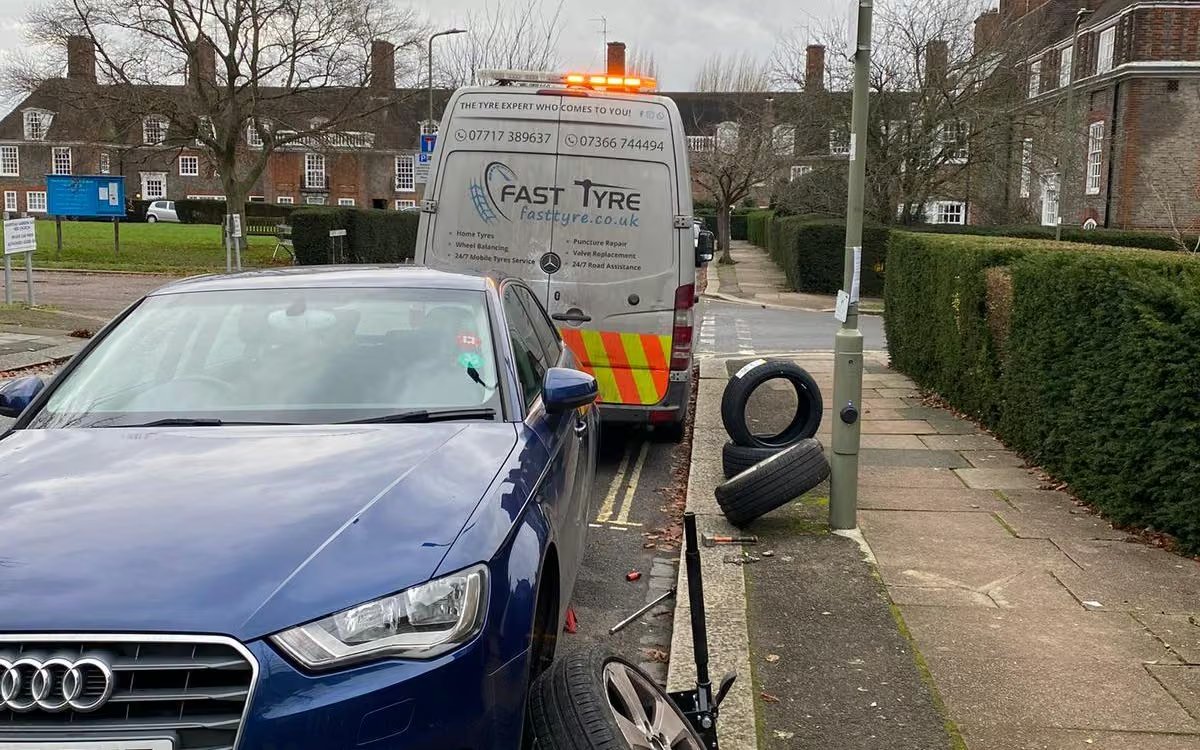
Burst Tyre Replacement in Hammersmith
Look at the driver's door pillar. On most cars there are two columns of pressures printed there, not one. The lower column is for the car as you normally use it.
Mobile burst tyre replacement across Hammersmith
That gap is where a good many blowouts begin. A tyre carries weight with air, not with rubber. Load it beyond what the pressure inside will support and the sidewall flexes further on every revolution, flexing makes heat, and heat parts the rubber from the belts underneath. A casing failing this way has not struck anything. It goes because it has been getting hotter for half an hour, which is why it happens on the long fast section rather than at the start.
All of it is worse the faster you go, and the A4 Great West Road is where a loaded car leaving this part of London first gets up to speed. Set the laden figures before you go and drop them again when the car is empty.
Two in the morning is when a blowout is worst and when help is hardest to find. A stop on King Street at that hour is a call we expect, not an unusual one. School run in Barons Court or 1am in King Street, we answer the same. Christmas Day in King Street, any day in Brook Green: the line is open. W6 takes in Ravenscourt Park and Shepherd's Bush, and we work the lot.

What you get with our burst tyre replacement in Hammersmith
- A blown tyre is a priority job, answered and dispatched fast
- The replacement travels with the fitter
- Safe roadside fitting right across Hammersmith
- The same service for a runabout and for a large 4x4
- Live ETA from the moment the van joins the A219
- Hammersmith Broadway or King Street at 3am is the same call as at 3pm
Burst tyre replacement in Hammersmith is part of our wider 24-hour emergency callout across London and the home counties cover. For burst tyre replacement in Hammersmith, call 07717 389637 or get a price for your tyre.
Local knowledge across Hammersmith
Cars in this borough spend most of their lives doing half a mile at a time at low speed, around the Broadway and King Street, then once or twice a year get loaded to the roof and pointed at the A4 Great West Road. We can come to a permit bay and set all four before you leave.
Burst Tyre Replacement call-outs we handle in Hammersmith
Loaded to the roof, pressures set for the school run
Four people, a boot packed solid and tyres last checked when the car was empty. The nearside rear let go on the A4 after twenty minutes of fast running. Nothing had hit it. We fitted a replacement and reset the other three to the laden figures.
Numbers borrowed from the last car
A driver had been setting pressures from memory, using figures that belonged to a car sold two years earlier. Same wheel size, very different weight, very different recommendation. Both rears had been running well under what this car asks for.
The figure moulded on the tyre
Someone had read the pressure marked on the sidewall and set all four to it. That number is the tyre's maximum, not the car's recommendation, and it comes from the tyre maker rather than whoever built the car.
What Hammersmith drivers say about our burst tyre replacement
★★★★★ 4.9 · based on 155 Google reviews
I was broken down in the middle of the A406, late at night. I called and they arrived within 15 minutes. Very fast and amazing service, and a kind, friendly gentleman got me moving quickly.
Google review
Honestly wish I could give more than 5 stars! Last night after leaving Wembley we got a flat tyre, stranded 2 hours from home, and these guys got us back up and running. 10/10 service from start to finish, even at 1am!
Google review
Really great service to repair a flat tyre. Easy to coordinate via WhatsApp, arrived promptly, good communication and a fair price.
Google review
Burst Tyre Replacement in Hammersmith, FAQs
The driver's door pillar is the usual place, sometimes the fuel filler flap, and the handbook always. Look for a table rather than a single number: it shows a light load and a full load, often with different figures front and rear.
Cold, meaning before the car has been driven or a couple of hours after it stops. A warm tyre reads higher than it is. The mistake that follows is letting air out to reach the printed number, which leaves the tyre underinflated once it cools.
It warns you once a tyre is already a long way down, and it exists to catch a puncture rather than to keep a laden car properly inflated. Plenty of cars will let you drive a fully loaded journey at pressures the system never complains about.
No. When a tyre fails from heat the belts and the rubber have parted across a wide area and there is nothing solid to repair into. It is a replacement, and its pair on the same axle is worth a look, having had the same treatment.
Burst Tyre Replacement in Hammersmith, 24/7
Prefer a callback? Send your details for a burst tyre replacement price in Hammersmith.