
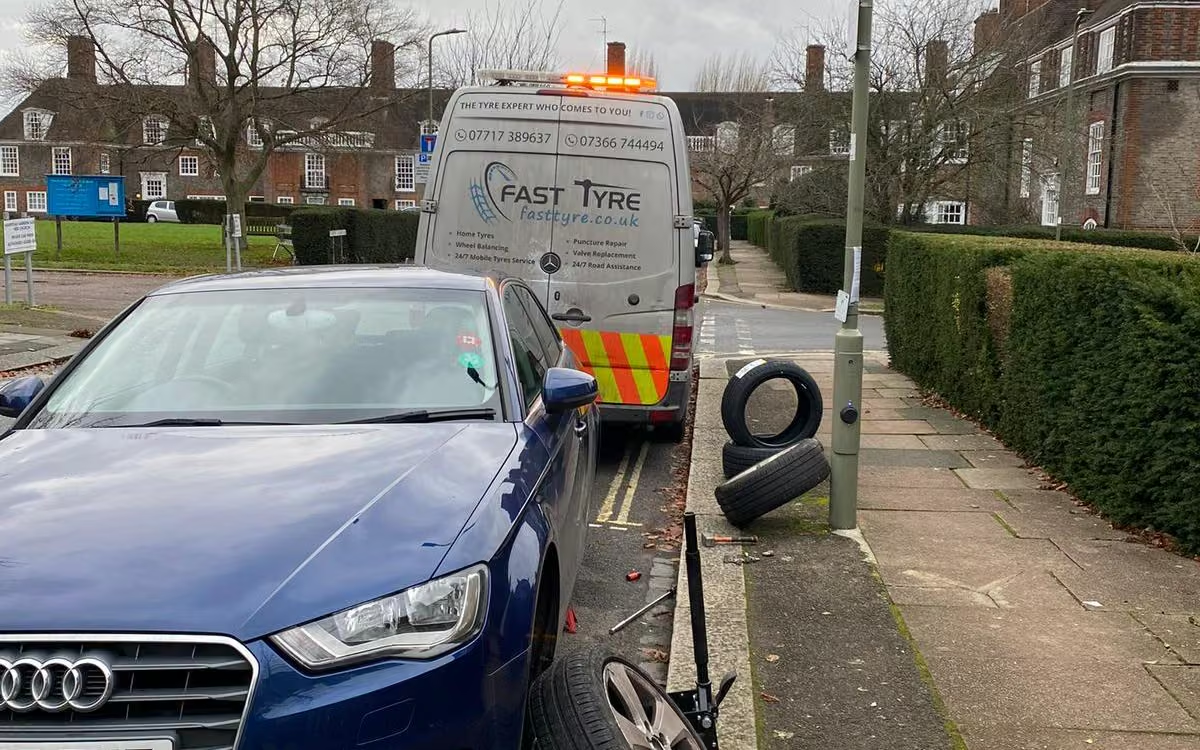
Mobile tyre replacement across Camberwell
The wet performance of a tyre falls away gradually from new and then drops sharply. Independent wet braking tests put the steep part of that curve at around three millimetres for most patterns, which means a tyre can be entirely legal and still need a good deal more road to stop on a soaked surface than its driver has allowed for. Dry braking barely changes over the same range, which is precisely why it catches people out.
So the useful way to buy is to decide in advance what depth you will act at, rather than letting a test tell you. Three millimetres going into autumn is a sensible line. Book while the tyres are still legal, choose on wet grip, and have the set fitted at home or at work on a day that suits you.
Across SE5, most of the tyre fitting we do happens on a driveway or in a work car park rather than on a ramp. It saves the queue, and it saves the bit that matters more, which is driving on a tyre you already know is finished on a road like the A202. Whether it is Denmark Hill in rush hour or Coldharbour Lane at midnight, we answer. On Denmark Hill, day or night, Myatt's Fields included, arrival across SE5 runs 30 to 60 minutes. SE5 takes in Loughborough Junction and Walworth, and we work the lot.

What you get with our tyre replacement in Camberwell
- Greater London drivers pick the tier; premium, mid-range or budget, and we fit it
- Every wheel we fit is balanced before we pack up
- Every Camberwell fitting ends with pressures set to spec
- Nothing abandoned at the roadside on the A2217 or the A215
- Whatever is on the drive in Camberwell town centre, car, SUV or 4x4, we fit it
- You pay at the vehicle, by card or contactless
Tyre replacement in Camberwell is part of our wider mobile tyre fitting across London and the home counties cover. For tyre replacement in Camberwell, call 07717 389637 or send us your details for a price.
Local knowledge across Camberwell
Getting a car across the junctions around Camberwell Green in the rain means a lot of stopping on a surface polished smooth by traffic, and that is exactly the driving where the gap between three millimetres and the legal limit turns into real distance. Planning a set in advance means it happens on your driveway on a quiet morning.
Tyres call-outs we handle in Camberwell
Booked before the weather turned
A driver up towards Denmark Hill had all four at a little over three millimetres in September and decided against another winter on them. A full set went on the drive and was balanced within the hour, with nothing urgent about any of it.
An advisory that meant something
An advisory reading of two millimetres is not a warning about legality. It is a warning that the tyre has already left its useful range. On a car near Camberwell Green two advisories became two new front tyres that week.
Same size, a full band apart
Two options in one fitment, both from names people recognise, separated by a whole grade on wet grip. Shown side by side the owner picked the better one. Reading the label takes ten seconds and it is measured the same way for everybody.
What Camberwell drivers say about our tyre replacement
★★★★★ 4.9 · based on 155 Google reviews
Called at 10am, the fitter arrived with Bridgestone tyres at 10:45am and was finished by 11:15am. Very reasonably priced and great communication, would definitely use again.
Google review
Amazing service. Popped my tyre and they were out in 10 minutes with a new tyre and back on the road.
Google review
Quality service and pleasant staff. Accurate arrival time estimation with constant ETA updates.
Google review
Tyres in Camberwell, FAQs
A depth gauge is a small thing to own and the only honest method. Failing that, the wear bars in the base of the main grooves sit at the legal limit, so tread level with them means the tyre is done. Measure in three places across the width.
They do, and low mileage cars are the ones it catches. Rubber hardens and the sidewalls begin to craze from the surface inward. The four digit code moulded into the sidewall gives the week and year of manufacture, and past the first decade depth stops deciding.
It is the one rating we would spend on. It comes from a braking test on a wet surface and the bands are meaningful, so a tyre two grades better genuinely stops in less distance. Read the other figures once that has narrowed the field.
Across the car yes, provided each axle carries a matched pair. Front and rear can differ without real trouble. What you should not do is put two different patterns on the same axle, because the two ends behave differently under braking.
Tyres in Camberwell, 24/7
Prefer a callback? Send your details for a tyre replacement price in Camberwell.