
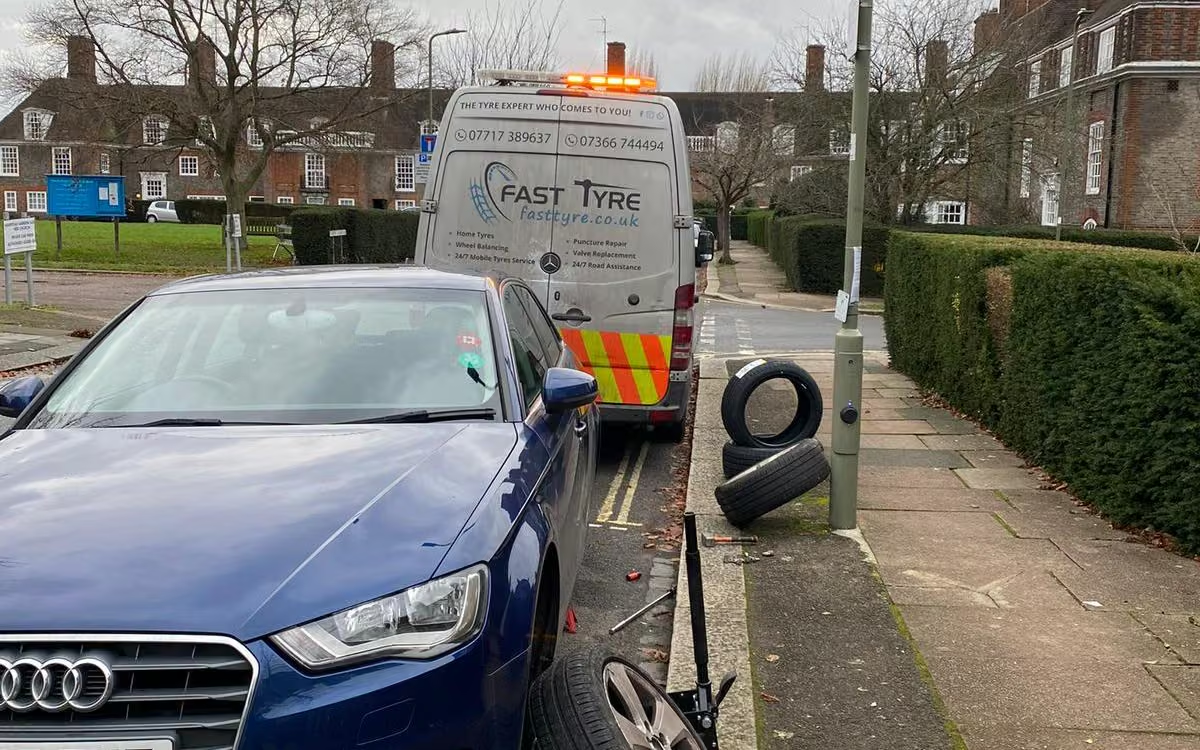
Tyres in Pimlico
A wheel is not hanging on the studs. It is clamped flat against the hub face, and it is friction between those two mating surfaces that stops it moving.
Mobile tyre replacement across Pimlico
What happens next is predictable. The nuts go on correctly, the car is driven, and over the first few miles all that debris crushes down into nothing. The gap it occupied disappears, the clamp load falls away with it, and nuts that were right in the morning are slack by the end of the week. That is why the faces get cleaned back to metal before the wheel goes on, and why it is worth having the nuts checked again after the first proper drive. Buying a set of tyres is a planned job with time in it, so there is no reason for either step to be skipped.
Front tyres wear first, and hills and stop-start traffic make it worse. Anywhere with a lot of braking and turning, Lupus Street included, chews the outer shoulders long before the middle of the tread goes. A Warwick Square cul-de-sac or a St George's Square main road, tell us which. A tight terrace in Churchill Gardens or a narrow bay on Grosvenor Road is usually workable. SW1V takes in Lupus Street and Belgrave Road, and we work the lot.

What you get with our tyre replacement in Pimlico
- Tell us where you are on Belgrave Road or Grosvenor Road and the tyre comes with us
- The balancer travels with the van, whether you are in Warwick Square and Dolphin Square area
- Set to spec, not to whatever was in there before
- Old tyres removed and recycled responsibly
- Greater London cars, SUVs and 4x4s all covered
- Contactless and chip and pin both taken on site
Tyre replacement in Pimlico is part of our wider mobile tyre fitting cover. For tyre replacement in Pimlico, call 07717 389637 or ask us for a quote.
Local knowledge across Pimlico
Cars around Churchill Gardens and St George's Square do short trips and then stand at a kerb for days, and hubs corrode faster on a car used that way than on one that is out every morning. That corroded ring is the surface a wheel has to clamp against. We clean it back to metal before anything goes on, and it is still worth having the nuts rechecked after the first proper drive, because whatever settling is going to happen happens in those first few miles and nowhere afterwards.
Tyres call-outs we handle in Pimlico
Flaked back to bare metal
A set of four fitted on a car near Churchill Gardens, with every hub face wire brushed first. Two of them had a genuine crust of scale that would have crushed flat within a fortnight.
Slack nuts, sound fitting
A driver found nuts loose a week after a wheel change elsewhere and assumed they had been left undone. They had been tightened properly onto a dirty face, which produces exactly the same result.
Corrosion left by an old wheel
Where an alloy had sat against a steel hub for years, the contact ring was thick with white powdery corrosion. It came off before the new wheel went anywhere near it.
What Pimlico drivers say about our tyre replacement
★★★★★ 4.9 · based on 155 Google reviews
The guy I spoke to on the phone was very friendly and understanding, especially as having two tyres needing to be replaced was quite stressful. He arrived quickly, talked me through everything, and gave me honest advice. He also went above and beyond by checking other things on the car and explaining the condition of all my tyres.
Google review
Said is a very competent and courteous professional. Have used him several times with different challenges and never been disappointed.
Google review
A great guy and great service. Cheery, efficient and reasonably priced. Got me going back on the road in 25 minutes from arrival.
Google review
Tyres in Pimlico, FAQs
Because the clamp relies on the faces being in contact. Anything trapped between them, scale, grit or corrosion, gets crushed flat in the first few miles, and the tension in the studs drops by exactly the thickness that disappeared. The nuts have not undone themselves, the joint has settled.
It is simply checking the nuts again with a wrench after the wheel has done a short distance, which is when any settling has already happened. Once they hold their figure on that check, they are stable. It costs a minute and it is the cheapest insurance on the whole job.
Usually there is a warning, a light rhythmic knock at low speed or a faint clicking on turns, and it is easy to dismiss. If a wheel has recently been off and a new noise arrives, stop and check the nuts before doing anything else rather than waiting to see whether it settles down.
As standard, on every wheel that comes off. It is a couple of minutes with a wire brush and it decides whether the joint stays tight. It is also entirely invisible on the invoice, which is precisely why it is the step that gets left out when somebody is working against a clock.
Tyres in Pimlico, 24/7
Prefer a callback? Send your details for a tyre replacement price in Pimlico.