

Puncture Repair in Brixton
There are three ways to close a hole in a tyre and only one of them is a repair. A plug is a rubber stem pushed in from the outside, usually without the tyre leaving the wheel.
Mobile puncture repair across Brixton
The reason the standard asks for the combination unit is water. A patch on its own makes a tyre hold air perfectly well, so it feels like a success, but rain still runs into the channel through the tread and reaches the steel belts underneath. Steel rusts, the rust creeps along the belt, and eighteen months later the tread starts separating from a tyre that never once went soft. A plug on its own has the opposite fault: nothing bonded to the liner, and nobody has looked inside the casing at all.
BS AU 159 is not a technicality; it is the line between a tyre you can trust and one you cannot. In practice that means the wheel comes off at your kerb in Brixton town centre or wherever you have managed to park, on Brixton Hill included, the tyre comes off the rim, and the inside gets inspected for damage you would never see from the outside. Whether it is Loughborough Junction in rush hour or Coldharbour Lane at midnight, we answer. On Coldharbour Lane, day or night, Stockwell included, arrival across SW9 runs 30 to 60 minutes.
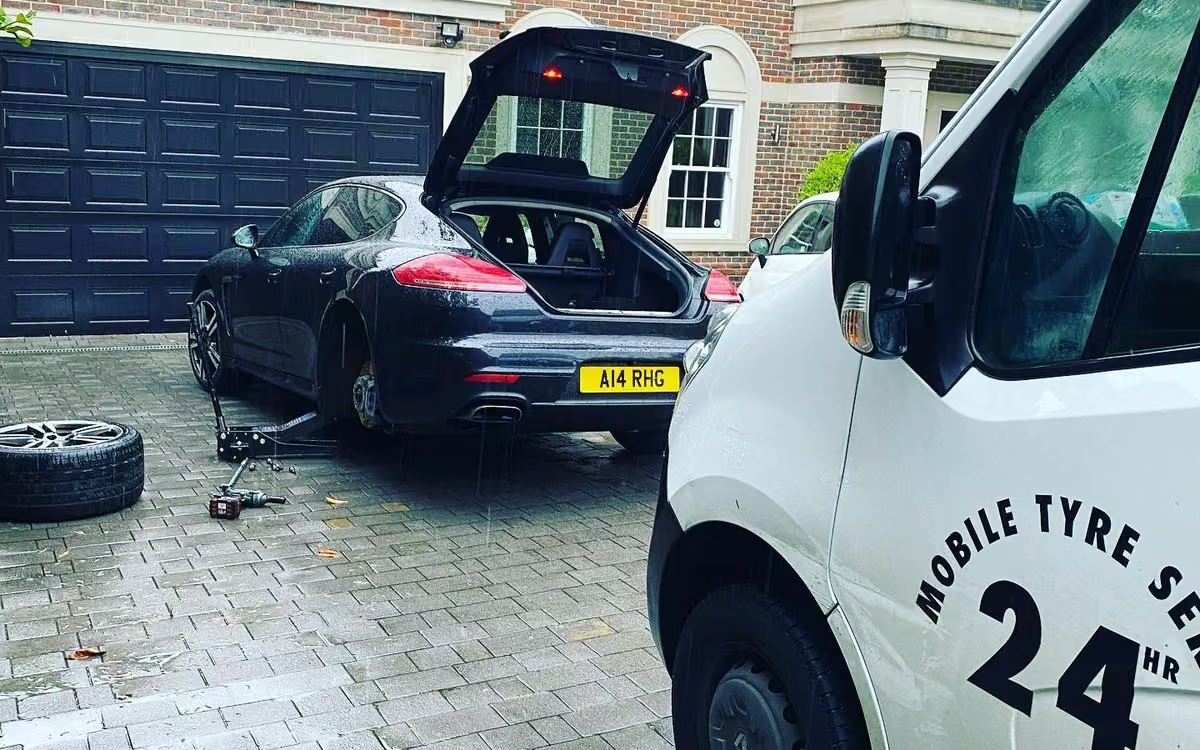
What you get with our puncture repair in Brixton
- Inspected properly in Tulse Hill and Brixton town centre, not glanced at
- Repaired from within, as BS AU 159 requires
- One visit anywhere in Greater London: off, repaired, refitted, re-balanced
- No Brixton job leaves under-inflated
- The same straight advice here as in Herne Hill and Clapham
- Same-day slots and emergency callout at any hour
Puncture repair in Brixton is part of our wider puncture repair across London and the home counties cover. For puncture repair in Brixton, call 07717 389637 or get a price for your tyre.
Local knowledge across Brixton
Most of what comes out of tyres in SW2 is small, sharp and shed by a road with a lot of loading and unloading beside it. Punctures here get found cold, on a drive or at the kerb, before anyone has driven any distance on them, and that is a tyre in its best possible condition for a proper repair.
Puncture Repair call-outs we handle in Brixton
Still holding air, still failing
A tyre patched somewhere else was holding pressure faultlessly and coming apart across the tread. Cutting into it showed rust running along the belt away from the old nail hole. The seal had done its job and the open channel had undone it.
The string kit from the boot
Somebody had used a forecourt repair kit on Brixton Road to get the car home, which is a fair use for one. What is not fair is leaving it in there. The string came out and a combination unit went in behind it.
Much bigger on the inside
A neat little hole in the tread opened up under the reamer into a torn channel well past the size any unit covers. From the outside it looked like a five minute job. It was a new tyre.
What Brixton drivers say about our puncture repair
★★★★★ 4.9 · based on 155 Google reviews
Really great service to repair a flat tyre. Easy to coordinate via WhatsApp, arrived promptly, good communication and a fair price.
Google review
Came and sorted a replacement tire within half an hour or so. Fast and efficient service.
Google review
Just been helped by Abdul. The best customer service experience ever. He went far above and beyond what we expected. An example for everyone to follow.
Google review
Puncture Repair in Brixton, FAQs
For getting a car off a road where it should not be sitting, yes, and that is the whole of it. Treat one as a way to move the car rather than a fix. The string has to come out afterwards, because it seals nothing inside.
Permanent. Done to the standard it is meant to outlast whatever tread is left on the tyre, not get you through the month. There is nothing to check and no reason to think about it again once the wheel is balanced and back on.
Because there is steel a couple of millimetres under the tread and only the rubber around it keeps the weather off. Open a channel down to it and it corrodes, and corroded belt loses its grip on the rubber it was bonded to.
Combination units come in sizes and the standard sets a limit on the diameter of the injury as well as on where it sits. Past that there is nothing made to fill it. We measure the hole after reaming rather than judging it by the nail.
Puncture Repair in Brixton, 24/7
Prefer a callback? Send your details for a puncture repair price in Brixton.