
Key takeaways
- National Highways guidance already covers this: if you cannot get out safely, stay in the vehicle, keep your seatbelt on and call 999.
- Say what you need on the call. Nobody can accommodate a requirement they have not been told about.
- Register your needs with your breakdown provider in advance rather than at the roadside. The AA runs a dedicated line for this.
- Keep the things that make a wait bearable in the car, not the boot, because the boot is the one place you may not be able to reach.
Almost every piece of breakdown advice contains the same instruction. Get out of the car. Leave by the door away from the traffic. Get behind the barrier and wait there. It is good advice, it is what the official guidance says, and for a great many drivers it describes something they simply cannot do quickly, or at all.
If you use a wheelchair, have limited mobility, are recovering from surgery, are heavily pregnant, or are travelling with someone who cannot be moved easily, the standard version of this advice quietly assumes a body you do not have. This is the other version.
What if you cannot get out of the car safely?
Then you stay in it, and that is the official answer rather than an improvisation. National Highways guidance is explicit: where you cannot exit the vehicle safely, remain inside, keep your seatbelt fastened, put the hazard lights on and call 999 and ask for the police. It is stated as the instruction for that situation, not as a concession.
That matters because the usual advice, repeated everywhere, can make staying in the car feel like a failure to follow the rules. It is not. The rule is to end up in the safest available place, and for a driver who would take several minutes to get out and could not then move clear of the carriageway, the safest available place is often belted into the vehicle with the emergency services on their way.
Where you break down changes the answer completely
The stay-or-go calculation is entirely different on a motorway from a residential street. On a fast road the danger is traffic and the clock is short. In a car park or outside your house there is no traffic risk, no reason to hurry, and staying comfortable in the car while you wait is simply the sensible choice rather than a safety decision at all.
| Where you are | If you can get out and clear | If you cannot |
|---|---|---|
| Motorway or fast dual carriageway | Leave by the side away from traffic, get behind the barrier | Stay belted in, hazards on, call 999 and ask for police |
| A-road with a verge | Get off the carriageway, well back from the traffic | Stay in the car, hazards on, call for help and say you cannot exit |
| Residential street | Either. There is no traffic-speed danger | Stay in the car. This is a comfort decision, not a safety one |
| Car park | Either, whichever is easier for you | Stay in the car and wait |
| Your own driveway | Go indoors | Go indoors, and leave a phone where you will hear it |
Say what you need on the call
Tell them at the start, not at the end. Whoever you ring — the police, a breakdown provider, or a mobile tyre fitter — is making decisions about priority and about what to send based only on what you tell them. A requirement nobody has been told about cannot be accommodated, and there is no prize for playing it down.
The things worth saying plainly:
- That you cannot easily leave the vehicle, and whether you are staying in it.
- Whether you are on your own, and whether anyone with you needs assistance.
- Whether you can reach the boot, since that is where the spare, jack and locking wheel nut key usually live.
- Any medical need that a long wait would affect, including medication, warmth or access to a toilet.
- Whether a wheelchair, frame or other equipment is travelling with you and needs to come along if the car is recovered.
That last point is the one most often forgotten and the most disruptive to get wrong. If a car is recovered without the equipment its driver depends on, the problem does not end when the car is moved.
The boot problem
On most cars the spare wheel, the jack, the brace and the locking wheel nut key all live under the boot floor. If reaching, lifting or kneeling is difficult, every one of those is effectively unavailable to you, which means a job that looks like a wheel change to the person on the phone is really a tyre job. Saying so early stops someone arriving equipped for the wrong thing.
Preparing before it happens
Register your needs with your breakdown provider now, while you are not at the roadside. This is the single most useful thing on this page, because it moves the conversation to a time when you are warm, unhurried and can find your policy number.
The AA publishes a route for exactly this: a dedicated accessibility line for registering a mobility impairment, speech or hearing loss, or a medical condition, plus access through Relay UK and by adding the 18001 prefix on a textphone. It also offers policy documents in large print, audio or Braille, and refers to an Onward Mobility Network of accessible vehicles for customers with certain cover levels who need one. Other providers have their own arrangements, and the detail differs, so ask yours directly what is recorded against your account.
Worth doing at the same time:
- Ask what is actually recorded on your file, rather than assuming a note from three years ago survived a system change.
- Check whether your cover attends at home, since a driveway breakdown is not covered by every policy.
- Find out what happens to a passenger who cannot travel in a recovery vehicle cab.
- Move the things that make a wait bearable out of the boot and into the cabin: water, a charger, a blanket, any medication you would want within an hour.
Getting the tyre sorted without getting out
A tyre changed at the car is the version of this that requires least of you. The relevant point is not the convenience: it is that a wheel change on a driveway or in a car park can happen while you stay exactly where you are, whereas driving to a garage on a space-saver, or being recovered to one, involves several transitions that a roadside advert never mentions.
What helps the person attending, if you are able to gather it from where you are sitting:
- The registration, and the tyre size from the sidewall if someone can read it for you.
- Which wheel, and whether the tyre is flat or just losing air.
- Whether the boot can be opened and reached.
- Whether the car has locking wheel nuts, and where the key is kept.
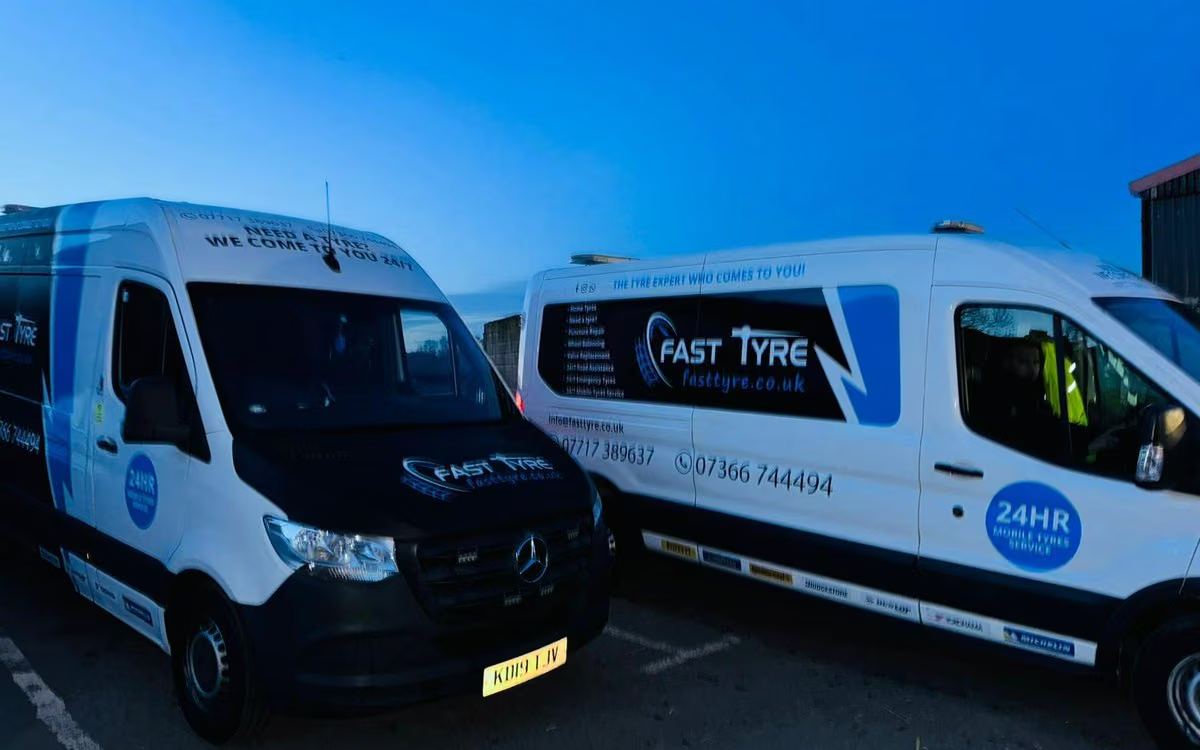
We come to the car and do the whole job there, so you do not need to leave it or drive anywhere afterwards. Tell us on the call what you need and we will work around it. Typically 30 to 60 minutes across London and the nearer Home Counties, longer further out, and you get a real arrival time rather than a guess.
If you are on a motorway right now, the safety sequence comes first. For getting help to the right place, see describing where you are, and what to do while you wait covers the preparation that shortens the job itself.
Frequently asked questions
Stay in it. National Highways guidance is that where you cannot exit safely you should remain in the vehicle with your seatbelt fastened, put the hazard lights on, and call 999 and ask for the police. That is the instruction for that situation, not an exception to it.
Fitting at the car is the version that asks least of you, because the whole job happens where the vehicle is standing and you do not have to travel to a garage or move afterwards. Say what you need on the call so it can be planned for rather than discovered.
Yes, and do it before you need them. The AA publishes a dedicated line for registering a mobility impairment, speech or hearing loss, or a medical condition, along with Relay UK and textphone access. Ask your own provider what is recorded against your account.
Say it regardless, but do not count on it. I could not find a published commitment from any major UK provider that vulnerable or disabled customers are prioritised. What they will do is act on what they know, which is why telling them matters even without a promise attached.
Say so on the call. On most cars the spare, jack and locking wheel nut key are all under the boot floor, so if you cannot reach them the job is a tyre job rather than a wheel change, and whoever attends needs to arrive equipped for that.
Ask before the recovery vehicle arrives, because it is easy to overlook in the moment. Equipment you depend on needs to travel with you, and a car recovered without it leaves the problem unsolved even though the vehicle has been moved.