
Puncture Repair in Bromley
The part of a puncture repair that decides whether it lasts is the part nobody watches.
Mobile puncture repair across Bromley
Then the cement goes on, and then it waits. Vulcanising fluid has to flash off until it is tacky rather than wet, which takes a few minutes and cannot be blown dry or hurried. Only then does the patch go down, stitched from the centre outward so the air rolls out ahead of it, because a bubble under one edge is where the failure starts.
That waiting is why a proper repair is not a five minute job, and why the ones that come back are almost always the ones that were.
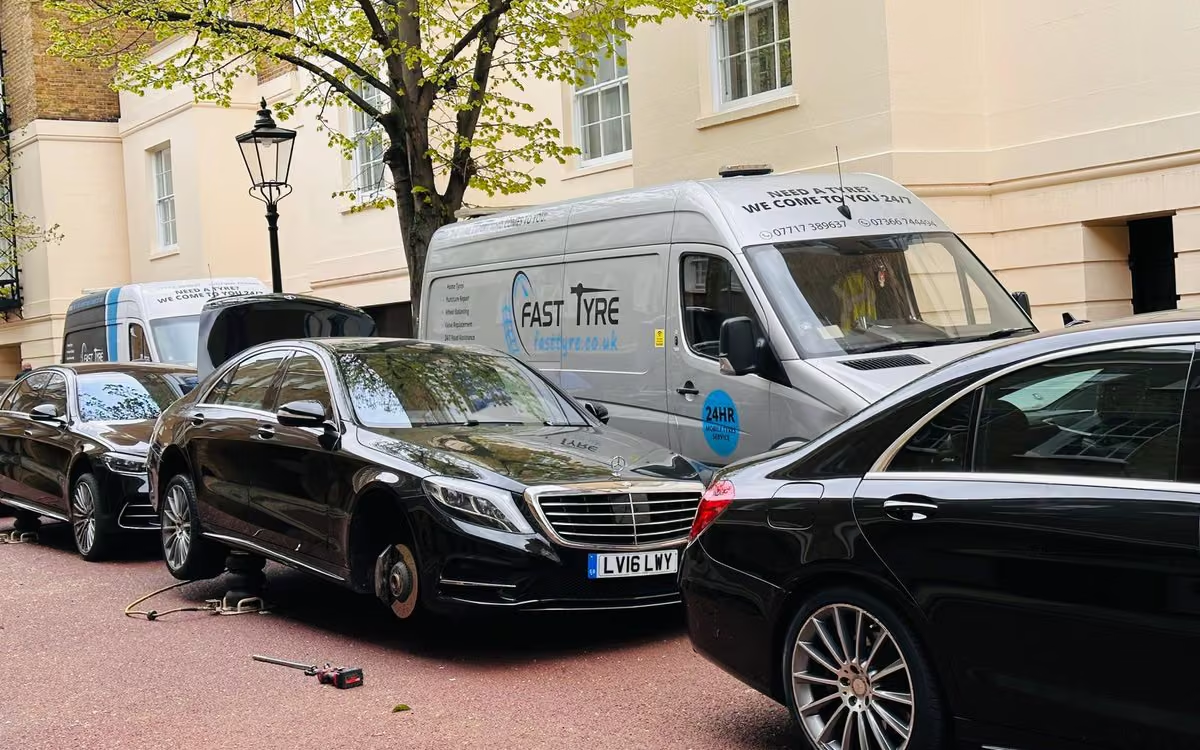
BS AU 159 is not a technicality; it is the line between a tyre you can trust and one you cannot. In practice that means the wheel comes off at your kerb in Shortlands or wherever you have managed to park, on the High Street included, the tyre comes off the rim, and the inside gets inspected for damage you would never see from the outside. Pressures set before we leave Shortlands, and the same on the High Street. A Shortlands driveway is our workshop, and so is a Bickley kerb. A BR1 address in Widmore and one in Masons Hill are the same round.

What you get with our puncture repair in Bromley
- Pulled up on the A2212 (Masons Hill)? The damage gets a full inspection first
- The proper internal repair, not a temporary plug
- The wheel comes off and goes back on balanced
- No Bromley job leaves under-inflated
- A straight answer in Shortlands: repair it, or replace it
- Same-day and emergency callout available 24/7
Puncture repair in Bromley is part of our wider puncture repair across London and the home counties cover. For puncture repair in Bromley, call 07717 389637 or send us your details for a price.
Local knowledge across Bromley
None of the preparation cares where the car happens to be, which is why this works as well on a driveway in Bickley or in a bay near The Glades as it would in a workshop. What does matter is somewhere the wheel can sit still and clean for a few minutes together, which a driveway gives you and a busy kerb often does not.
Puncture Repair call-outs we handle in Bromley
The patch that had lifted
A repair done elsewhere that had begun weeping round one edge inside a month. Peeling it back showed shiny rubber underneath with the mould release still on it. Nothing had ever gripped. The tyre was sound, so it was cleaned back properly and repaired again.
Cold morning, longer wait
Cement takes longer to go off in cold air, and a patch pressed down while it is still wet lifts later. On a February driveway near Shortlands that meant standing about a few minutes with the wheel in the warmth of the van.
Nail pulled, hole left open
Somebody had drawn the screw out at the kerb and carried on driving with the hole in the tread. Grit had been forced into it for two days. Reaming took it back to sound rubber and the repair held, but the object should have stayed put.
What Bromley drivers say about our puncture repair
★★★★★ 4.9 · based on 155 Google reviews
Super fast and efficient service. Came out and fixed my tyre on the spot, even though it was late. Fair price.
Google review
A great guy and great service. Cheery, efficient and reasonably priced. Got me going back on the road in 25 minutes from arrival.
Google review
Very quick call out and replace time, very good price and very polite.
Google review
Puncture Repair in Bromley, FAQs
Straight away. A chemically cured patch reaches working strength as it is fitted, unlike a hot vulcanised repair, so the waiting is all in the preparation rather than afterwards. What you should not do is drive on a repaired tyre that has not been rebalanced.
Not properly. Everything that makes a repair last happens on the inner face, and there is no reaching that with the tyre on the rim. A string pushed in from outside skips all of it, including the part where somebody checks what the object did on its way in.
It should outlast the tread. A patch bonded to a properly prepared liner becomes part of the tyre and holds at the original speed rating. The ones that fail are the ones where the surface was wrong to begin with.
No. The liner is a thin airtight layer rather than structure, and buffing takes a fraction of a millimetre off it across a patch the size of a coin. The strength sits in the belts and casing cords underneath, and neither is touched.
Puncture Repair in Bromley, 24/7
Prefer a callback? Send your details for a puncture repair price in Bromley.