
Key takeaways
- A mobile fitter can make a permanent puncture repair where the car is parked, to British Standard BS AU 159. The hole has to be in the central three-quarters of the tread, and the tyre must not have been driven flat.
- Sealant, external string plugs and space savers are temporary. TyreSafe is clear that neither plugs nor sealant count as a permanent repair.
- Shoulder damage, bulges, blowouts and tyres run flat cannot be repaired; sidewall damage almost never can. The answer is a new tyre fitted from the van.
- Valves, pressure sensors, missing locking wheel nut keys and balancing are done at the car. Wheel alignment, buckled wheels and anything on a live carriageway or hard shoulder are not.
A mobile tyre fitter can repair a tread puncture on the spot, permanently, to British Standard BS AU 159. That holds as long as the hole is in the repairable centre of the tread and the tyre has not been driven flat. This guide sorts every common problem into three piles: a repair on the spot, a new tyre from the van, or not a roadside job at all. First, the quick fixes that only get you moving.
Temporary fix or permanent repair: the difference that matters
Plenty of things will get air back into a tyre. Very few of them are a repair. TyreSafe, the UK tyre safety charity, puts it plainly. Neither externally applied plugs nor liquid sealants count as a permanent repair. A permanent repair can only follow removing the tyre from the wheel so it can be inspected inside and out.
| Fix | Temporary or permanent | What it is good for |
|---|---|---|
| Sealant from the car's repair kit | Temporary | A small tread puncture, to reach a fitter at reduced speed. The tyre still needs taking off and inspecting. |
| External string or plug pushed in from outside | Temporary | Nothing that should be sold as a finished job: the inside of the tyre is never seen. |
| Space-saver spare | Temporary | Getting home or to a fitter. TyreSafe says usually 50mph and no more than about 50 miles; check the wheel and your handbook. |
| Combination patch-plug fitted from inside, tyre off the rim | Permanent | A tread puncture inside the repair zone, on a tyre that has not been run flat. |
| New tyre fitted and balanced | Permanent | Anything outside the repair zone, or a tyre that is worn, run flat or burst. |
Why the tyre has to come off: the damage that decides the job is often on the inside. Michelin explains that driving at low pressure crushes the sidewall and marks the inner rubber, and that the tyre must be removed to check for it. The permanent fix is then a patch-plug pushed through from the inside, sealing both the hole and the inner liner.
None of that depends on a building. Our vans carry a tyre machine, a wheel balancer, an air line and tyres in the common sizes. So with the wheel off, a repair at the kerb follows the same standard and the same steps as one done in a workshop.
If you have already used sealant, tell the fitter when you call, so they know what is inside the tyre before it comes off. TyreSafe's kit guidance goes further and says to replace a tyre sealed with a kit as soon as you get home or to a garage, so the fitter can bring a tyre in your size in case a repair is ruled out. Our guide to the car's repair kit covers when the kit is worth using at all.
Can it be fixed where the car is? Three questions
A fitter works through the same three questions on every flat. You can answer the first two yourself from the kerb, which tells you roughly which pile you are in before you call.
Say you spot a screw head in the front tyre on the school run, and the tyre is soft but has not gone flat. If the screw sits in the middle of the tread and the inside is clean once the tyre is off, that is a permanent repair. It is patched, balanced and refitted on the drive in about 20 to 30 minutes. Now say the same screw were a centimetre or so further out, past the edge of the central three-quarters. That puts it in the shoulder, where the tread curves round towards the sidewall, and the answer would be a new tyre from the van. Both are worked examples of the rule, not records of particular jobs.
The repair zone: which punctures can be fixed
A puncture can only be repaired permanently if it sits in the minor repair area. TyreSafe describes this as the central three-quarters of the tread, and says repairs should follow BS AU 159. Its reason is that repairs in that band are less likely to affect the tyre's performance, wear or overall integrity. Outside it, towards the shoulder where the tread curves over, Michelin is blunt that a repair is not possible.
Being inside the zone is necessary but not enough. With the tyre off the wheel, the fitter checks these in order:
- The inside of the tyre. Michelin explains that driving at low pressure crushes the sidewall, which can mark the inside of the tyre or make pieces of inner rubber break off. TyreSafe lists signs of deterioration on the liner among the reasons a repair cannot take place. That tyre is finished, however neat the puncture looks.
- The size of the injury. A nail or screw is usually fine. Michelin's rule of thumb is that repair is usually possible unless the puncture is too large. In practice a gash or a tear is too large.
- Earlier repairs. TyreSafe lists previous repairs that are not in line with British Standards among the reasons a tyre cannot be repaired. So the fitter checks any earlier repair as well as the new damage.
- Tread depth. The legal minimum for a car is 1.6mm across the central three-quarters of the tread and around the whole circumference, under Annex 6 of the Highway Code. Repairing a tyre close to that line rarely makes sense.
Run-flat tyres are a special case. TyreSafe notes that several associations do not recommend repairing them, and its repair guidance says repairs to self-supporting run-flats are a question for the tyre's manufacturer. The full walk-through of the rule, run-flats included, is in can a puncture be repaired.
What cannot be repaired, however urgent it is
Some damage rules out a repair anywhere, roadside or workshop. A fitter who says so is applying the standard, not upselling.
- Sidewall cuts and splits: the wall flexes with every turn of the wheel, and Michelin says a sidewall puncture is generally not repairable. Our guide to sidewall damage explains why nothing holds there.
- A bulge or bubble: a sign of damage inside the tyre's structure. TyreSafe lists damage to the casing among the reasons a repair cannot take place.
- A blowout: the tyre has failed structurally.
- Shoulder punctures: outside the repair zone.
- A tyre run flat: the inner structure has been crushed even if the outside looks fine.
None of these leaves you stuck. They change the job from a repair to a replacement, and a fitter carrying tyres on the van does that on the same visit. If you already have the right tyre, we fit customer-supplied tyres too.
Other jobs a mobile fitter fixes at the car
A flat is not always a puncture. Several common causes are fixed on the spot without touching the tread.

- Perished or leaking valves. Rubber valves crack with age and leak slowly. A new valve is fitted with the tyre on the van's machine.
- Pressure sensor faults. A damaged or dead TPMS sensor can be swapped and the warning light dealt with at the car.
- Missing or damaged locking wheel nut key. Without it the wheel cannot come off, so the fitter can remove the locking nut first.
- Balancing. Every repaired or new tyre is balanced on the van, so there is no separate garage visit for a vibration afterwards.
- Leaks at the rim. Air can escape where the tyre seats on the wheel rather than through the tread. With the tyre off, the fitter looks at the bead and the rim. TyreSafe lists damage to the bead among the reasons a repair cannot take place, and a damaged rim is a wheel specialist's job (see below).
What a mobile fitter will not do at the roadside
A few jobs are off the table, and it is better to know before you call.
- Work on a live carriageway, motorway hard shoulder or slip road. The Highway Code says not to attempt repairs on a motorway. Get out on the side away from traffic if it is safe, and wait behind the safety barrier where there is one. Then:
- If you cannot get to a safe place, keep your seat belt and hazard lights on, stay in the car and call 999.
- Once you are in an emergency area, a lay-by or on the hard shoulder, call National Highways on 0300 123 5000.
- Wheel alignment or tracking. That needs a fixed alignment rig. We do not offer it; a tyre wearing on one edge needs an alignment centre.
- Straightening a buckled wheel or repairing a cracked alloy. That is a wheel specialist's job, and TyreSafe advises against fitting tyres to damaged or distorted rims. A badly damaged wheel may need recovery rather than a tyre.
- Faults that are not the tyre. Suspension, brakes or a car that will not start are for your breakdown cover or a garage. Our comparison of breakdown cover and a mobile tyre fitter explains who does what.
What to tell us on the phone
A two-minute call decides whether the fitter arrives ready to repair, ready to replace, or both. Have these to hand:
- Where the car is, as exactly as you can: postcode, road name or a landmark, and whether it is on a drive, at the kerb or in a car park.
- Where the damage is: middle of the tread, near the edge, or on the side wall. A photo on WhatsApp helps.
- Whether it has been driven on while flat, and roughly how far.
- The tyre size from the sidewall, for example 205/55 R16 91V, so the right replacement is on the van if a repair is ruled out.
- Whether you have the locking wheel nut key, usually in the glovebox or boot.
- Anything already tried: sealant, a plug, or the space saver already on.
- Whether the tyres are run-flats, often marked RSC, ROF, RFT or SSR on the sidewall.
How long does an on-the-spot repair take?
Once the fitter is with you, a puncture repair or a tyre replacement takes around 20 to 30 minutes. That covers lifting the car, taking the wheel off, breaking the bead, inspecting the inside, repairing or fitting, balancing, refitting and setting the pressure. The longer part is getting to you, which with Fast Tyre is typically 30 to 60 minutes, at any hour.
Flat at home or work: leave the car where it is
If the car is parked safely and the tyre is not fit to drive on, leave it where it is. The Highway Code says to stop as soon as it is safe and only change a tyre yourself if you can do so without risk. Driving on a flat can also turn a repairable puncture into a new tyre. Our emergency tyre repair service brings the repair, or the replacement, to the car day and night, with no out-of-hours surcharge.
Tell us where the damage is and what the tyre is doing. We inspect it against the BS AU 159 repair zone before anything is done, repair it where the standard allows, and fit a new tyre from the van where it does not. You get the price on the phone before anyone sets off.
Still deciding between your breakdown cover, a garage and a fitter? Our guide on who to call when you get a flat walks through it, and the mobile puncture repair page sets out how we repair on the drive or at the kerb.
Sources
Checked on 2 October 2026. BS AU 159 itself is a paid British Standard that we have summarised from the TyreSafe and Michelin guidance below rather than quoted. This guide gives no numeric limits from it for that reason.
- TyreSafe: Punctures and puncture repairs, Tyre repair and spares, Emergency puncture repair kits and Space saver tyres
- Michelin UK: Tyre repair: is my tyre repairable? and How to use a car tyre sealant
- GOV.UK, The Highway Code: Annex 6, vehicle maintenance, safety and security and Breakdowns and incidents (rules 274 to 287)
- National Highways: Breakdowns
How this guide was written: by Abed Jabbarkhel for Fast Tyre, with every technical and legal point checked against the public sources above on the date shown. Anything about how we work, such as arrival and fitting times, comes from Fast Tyre itself. If you think something here is wrong or out of date, tell us on 07717 389637 or on WhatsApp.
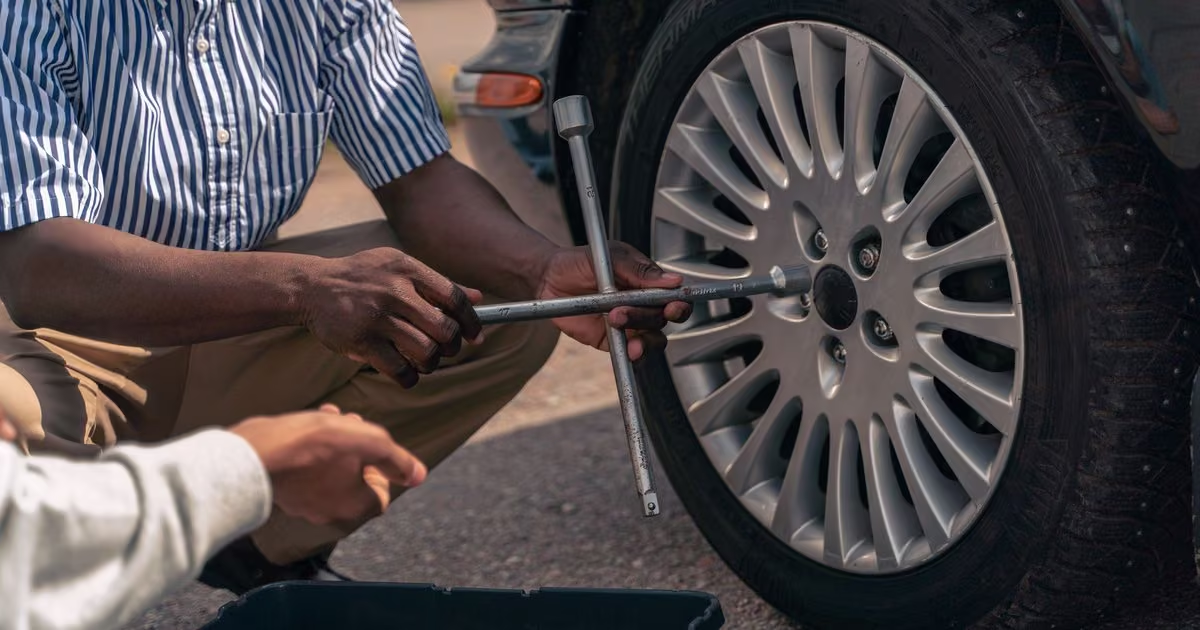
Photo: a Fast Tyre kerbside wheel change on a London street, from our own job photos (shown in the header and again in the article).
Frequently asked questions
Yes. A mobile fitter with a tyre machine and balancer on the van can take the tyre off the wheel, inspect it inside and fit a permanent patch-plug repair to BS AU 159. Those are the same steps a workshop follows. If the damage is outside the repair zone or the tyre has been run flat, they fit a new tyre instead on the same visit.
Yes, when it is a patch-plug fitted from inside with the tyre off the wheel, to BS AU 159. The standard does not change with the location. What does change is that you have not driven anywhere on a damaged tyre to get it done.
They are good at one thing: sealing a small tread puncture well enough to reach a fitter at reduced speed. TyreSafe advises against using one if the wheel rim is damaged, the tyre has been flat for a while, the hole is larger than 4mm or it is outside the main tread. A kit is a temporary measure, not a repair; the tyre still needs taking off and inspecting.
Usually, if the nail is in the central three-quarters of the tread and the tyre has not been driven flat. The tyre comes off the wheel, the inside is inspected and a patch-plug is fitted. A nail near the shoulder or in the sidewall means a new tyre.
Sometimes. TyreSafe lists previous repairs that are not in line with British Standards among the reasons a tyre cannot be repaired, and the new damage must also be in the central three-quarters of the tread. So it depends on how the earlier repair was done and where the new damage is. The fitter checks for earlier repairs during the inside inspection and tells you if another repair is ruled out.
It depends on whether the tyre can be repaired or needs replacing, and on the tyre. We quote on the phone before anyone sets off, with no surcharge for nights, weekends or bank holidays.
Leave the car where it is rather than driving it to a garage, and have the tyre repaired or replaced on the drive or at the kerb. The Highway Code says only to change a tyre yourself if you can do it without risk. Have the locking wheel nut key and the tyre size ready when you call.