
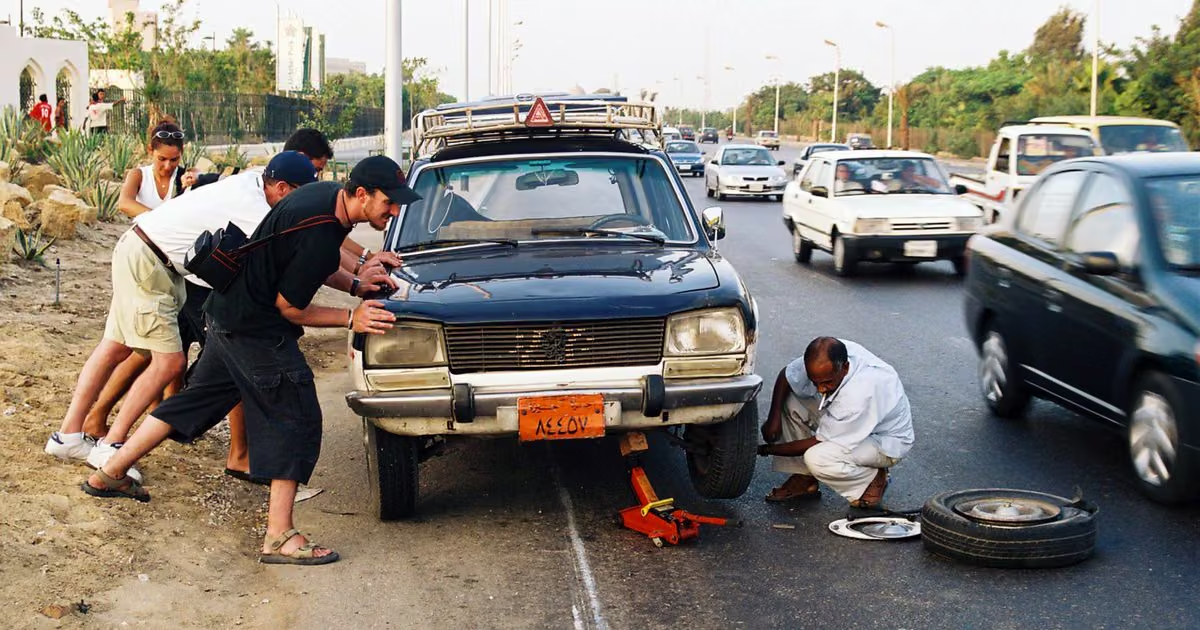
Key takeaways
- Breakdown cover is a recovery service, not a tyre supplier. Patrols typically fit your spare or recover you.
- The AA states on its own site that it does not provide new tyres or permanent repairs at the roadside.
- If your car has no spare, a patrol often cannot resolve it at all and the vehicle gets recovered.
- Tyre add-ons exist but carry caps and exclusions, and cover bought after you have broken down generally will not apply.
There is a moment, standing next to a flat tyre, when most drivers reach for their breakdown cover and assume the problem is solved. Sometimes it is. Often it is not, and the reason is structural rather than anything to do with the patrol who turns up: breakdown cover is a recovery service, and recovery is not the same as replacing a tyre.
Will breakdown cover replace a flat tyre?
Generally no. Standard breakdown cover exists to get you and the vehicle to safety, not to sell and fit a new tyre at the roadside. In practice a patrol will fit your spare if you have a usable one, attempt a temporary fix, or recover the vehicle to a garage if neither is possible.
The AA sets this out plainly on its own site: patrols "can change or temporarily fix a flat tyre at the roadside", and "if you have a spare, we'll fit it on the spot", but "you'll need to pay for the tyre repair or replacement yourself. We don't provide new tyres or permanent tyre repairs at the roadside." That is not a criticism of the AA. It is what the product is, and it is worth knowing before you are standing on a verge assuming otherwise. Terms differ between providers and change over time, so check your own policy rather than relying on any summary.
So what will a patrol actually do?
Three outcomes cover almost every tyre call-out.
- Fit your spare. The common outcome when the car carries a full-size or space-saver spare and the wheel will come off.
- Attempt a temporary fix. Usually sealant, which only works on small punctures in the tread and is explicitly temporary.
- Recover the vehicle. The default when there is no usable spare, or the damage rules out any roadside fix.
Recovery solves the immediate problem of being stuck. It does not solve the tyre, and the car is now at a garage rather than where you need it to be.
The problem if your car has no spare
This is where the assumption breaks down most often, because a large share of newer cars are sold without a spare wheel at all, carrying a sealant kit instead. Our guide on what to do with no spare tyre covers the options in detail.
If there is no spare, the patrol has nothing to fit. Sealant may work if the puncture is a small one in the tread, and will not if the damage is in the sidewall or shoulder. Under the industry guidance on BS AU 159, published by the British Tyre Manufacturers Association, repairs are confined to the central portion of the tread; sidewall and shoulder damage is not repairable. When sealant is out and there is no spare, recovery is usually what is left.
What about a tyre cover add-on?
Several providers sell tyre cover as an extra, and it can be worth having, but the detail matters. The AA's published tyre cover terms at the time of writing include a contribution of up to £160 towards each tyre, a limit on the number of tyres per year, no excess, and exclusions covering the first days of the policy, wear and tear, and tyres already below the legal tread limit.
Two of those exclusions catch people out. A tyre worn below the limit is excluded, and the legal minimum in the UK is 1.6mm across the central three-quarters of the breadth around the entire circumference, which is also the threshold the DVSA MOT Inspection Manual treats as a dangerous defect. And cover generally does not apply from the moment you buy it, which matters if you are reading this at the roadside.
What if you have no cover at all?
Then buying it now is unlikely to help. The RAC's own advice to drivers who have already broken down is not to buy a policy at that point, because cover typically does not start immediately. That leaves two realistic routes: a pay-as-you-go recovery callout, or a mobile tyre fitter who comes to you and resolves the actual problem.
For a tyre specifically, the second is usually both faster and more complete, because it ends with a tyre on the car rather than the car on a truck.
Which should you call?
| Your situation | Better call | Why |
|---|---|---|
| Usable spare in the boot, safe place to work | Either | Both can fit a spare; whoever reaches you first wins |
| No spare, tyre beyond a sealant fix | Mobile tyre fitter | A patrol has nothing to fit; a fitter brings the tyre |
| Sidewall damage or a bulge | Mobile tyre fitter | Not repairable, so it needs replacing rather than recovering |
| On a motorway or in a live lane | Emergency services first | Safety comes before either; see below |
| Car will not start, or the fault is not the tyre | Breakdown cover | This is what recovery is actually for |
Can you use both?
Yes, and sometimes that is the sensible answer. If you are somewhere genuinely dangerous, getting to safety comes first and is what breakdown and emergency services are for. On a motorway the Highway Code's breakdown rules are unambiguous: get the vehicle off the carriageway where you can, leave by the left-hand doors, and wait behind the barrier rather than staying with the car. National Highways publishes the same "go left" guidance and a dedicated number, 0300 123 5000, for its network.
Once you are safe and the car is somewhere a fitter can work, a mobile fitter finishes the job the patrol was never going to finish. Our guides on staying safe during a night-time breakdown and a pressure warning on the motorway cover the safety half properly.
Getting the tyre actually sorted
The honest summary is that the two services answer different questions. Breakdown cover answers "how do I stop being stuck". A mobile fitter answers "how do I get a working tyre on this car, here".
We carry the tyre, the machine and the balancer, so the job finishes where the car is standing rather than at a garage tomorrow. Typically 30 to 60 minutes across London and the nearer Home Counties, longer further out, and you get a real arrival time on the call.
If you are not yet sure whether the tyre can be saved, start with what can be fixed on the spot, or see 24-hour emergency callout.
Frequently asked questions
Usually not. Standard cover is a recovery service: a patrol will typically fit your spare or recover the vehicle. The AA states on its own site that it does not provide new tyres or permanent repairs at the roadside. Some providers sell a separate tyre add-on with its own caps and exclusions.
Providers generally treat it as one, in the sense that they will attend. What differs is the outcome: attending is not the same as replacing the tyre. Check what your policy says it will actually do, not just whether it will come out.
The RAC advises against it, because policies typically do not start immediately. If you are already at the roadside, a pay-as-you-go recovery callout or a mobile tyre fitter is the realistic route.
That is the practical alternative when the tyre itself is the problem. Give your postcode and the size from the sidewall and you will be told on the call whether someone can reach you and roughly when.
Safety first, always. On a motorway follow the Highway Code and National Highways guidance: get off the carriageway if you can, leave by the left, get behind the barrier and call for help. The tyre is a second-order problem.