Key takeaways
- In a tyre blowout, grip the wheel firmly with both hands, keep the car straight and come off the accelerator. Do not brake hard or swerve. The Highway Code says to let the car roll to a stop at the side of the road.
- Hazard lights on, and only steer gently to the side once your speed has dropped right off.
- On a motorway, leave at the next exit or services if you can, otherwise go left. Get out on the side away from traffic, wait behind the safety barrier where there is one and call National Highways on 0300 123 5000. Stuck in a live lane? Stay in, belt on, call 999.
- A burst tyre cannot be repaired. TyreSafe, Goodyear and Pirelli link blowouts to under-inflation, overloading and impact damage, and all of those can be checked for.
If you have a tyre blowout, the Highway Code says to "grip the steering wheel firmly and allow the vehicle to roll to a stop at the side of the road": hold it straight, ease off without braking hard or swerving, and follow the four steps below.
A blowout, also called a burst or blown tyre, is a sudden, total loss of air, usually with a loud bang.
What to do if you have a tyre blowout
- Grip the wheel firmly with both hands and keep the car pointing straight down your lane. Correct any pull with small, steady steering inputs rather than one big one.
- Come off the accelerator smoothly. Do not brake hard or swerve. If you need to brake, do it gently, in a straight line, once the car is under control.
- Hazard lights on, to warn the drivers behind, and let the car roll and slow down by itself.
- Steer gently to the side only once you are down to a low speed, then stop as far from traffic as you can reach.
Gripping the wheel and letting the car roll to a stop at the side of the road come from the Highway Code. Its instruction to "allow the vehicle to roll to a stop" is also the basis for not braking hard. Kwik Fit, a tyre retailer, says the same thing: the most important thing is not to apply the brakes suddenly.
Why not brake hard. With one tyre gone, hard braking pulls the car unevenly and can start a slide. The reflex is to stamp on the brake and yank the wheel away from the pull, and that is the pair of moves to avoid.
Rehearse it. Run through "hold, straight, ease off" in your head before it ever happens, so the order is already familiar if it does.
What happens when a tyre blows?
You hear a bang, sometimes followed by a flapping or thumping noise as the tyre breaks up, and the car pulls towards the side of the failed tyre. How it usually feels depends on which end has gone. This is general driving and trade experience, not a published standard:
- Front tyre: it comes straight through the steering. The wheel feels heavy and tugs to one side.
- Rear tyre: it comes through the seat more than the wheel. The back of the car sways or wanders, more so if you brake.
Is a tyre blowout dangerous? It can be, mainly at speed. Michelin warns that a sudden loss of air while driving fast, for example on the motorway, can cause loss of control and lead to an accident. That is why the drill above is about keeping the car straight and slowing it gently.
How common are tyre blowouts? UK road statistics do not count blowouts on their own. The nearest figure is in the Department for Transport's road casualty tables (table RAS0701, final results for 2025). In 2025, police recorded defective tyres as a factor in 447 reported collisions in Great Britain, 9 of them fatal. That covers every kind of tyre defect, not only blowouts, and only collisions a police officer attended.
Tyre blowout on a motorway
The drill in the car is the same. What changes is where you stop, because a motorway verge is not a safe place to stand. The Highway Code (rules 275 to 277) and National Highways give the same three steps:
- Go left. If the car can still move safely, leave at the next exit or pull into a service area. If you cannot, move into the left lane and into an emergency area, lay-by or onto the hard shoulder. Stop as far left as you can, wheels turned to the left, hazards on.
- Get safe. Get out on the side away from traffic and wait behind the safety barrier, where there is one. Do not go back to the car, even if it is raining, cold or dark. Do not try any repair, and do not put a warning triangle out on a motorway.
- Get help. Use the free emergency phone or call National Highways on 0300 123 5000, then your breakdown recovery service.
Use the hard shoulder only if there is nowhere better. Rule 275 says hard shoulders give less protection than other places of relative safety, because they are so close to high-speed traffic.
If you are stuck in a live lane, or it is not safe to get out, stay in the car with your seat belt on and hazards flashing, call 999 and ask for the police. If your car has an SOS button, you can press that instead.
On a smart motorway with no permanent hard shoulder, aim for an emergency area. Rule 270 says these are marked by blue signs with an orange SOS telephone symbol and may have orange surfacing. To leave one, rule 278 says you must use the emergency telephone and follow the operator's advice. Our guide to a flat tyre on a smart motorway with no hard shoulder goes through it in more detail.
Telling them where you are. Rule 277 lists three ways: the car's SOS (eCall) button, a map app on your phone, or the numbers and letters on the marker posts or driver location signs at the roadside.
A worked example (hypothetical, not a real job). Say the nearside front tyre bursts on the M25 at 60 mph and the steering pulls left. Hold the wheel, stay in lane, ease off and put the hazards on. With no exit or emergency area in reach, steer gently onto the hard shoulder, stop well left with the wheels turned left, and get everyone out through the nearside doors to wait behind the barrier. Call National Highways on 0300 123 5000 with the marker-post number, then your recovery service. The new tyre goes on once the car is off the motorway.
A blowout on the motorway is a recovery job first. Nobody should change a wheel there, and TyreSafe says the same for any busy road. We never work on a live carriageway, a hard shoulder or a slip road. We fit the new tyre once the car has been taken off the motorway.
After you have stopped
Off the motorway, once the car is stopped somewhere safe:
- Handbrake on, hazards left on, everyone out on the side away from traffic.
- Look at the damage without touching it. A burst tyre is often torn open along the sidewall, and any steel cords left exposed can be sharp, so keep bare hands off it.
- Look into the wheel arch. A tyre breaking up can tear the plastic arch liner or mark the bodywork.
- Look at the tyre on the other side of the same axle. If the blowout came from overloading or low pressure, that tyre has been through the same conditions.
- Decide on the fix. A usable spare and a safe spot off a fast road mean you can change the wheel yourself. A sealant kit cannot seal a tyre that has torn open. With no spare, read what to do when you have no spare, or ring for a new tyre to be brought to you.
Can you drive on a blown tyre?
No, only as far as you must to get out of danger. With no air in it, the tyre is squashed between the wheel rim and the road. Continental explains that driving on with the sidewall pinched like that spreads the damage. Running on the rim also damages the wheel and makes the car hard to steer and stop. Our guide on whether it is safe to drive on a flat tyre covers the few metres that are reasonable to get somewhere safer.
Run-flat tyres have a reinforced sidewall that TyreSafe says is designed for up to 50 miles at a maximum of 50 mph, and that several associations do not recommend repairing. Its FAQ adds that recommendations differ between tyre makers, so check the car's handbook.
It is also against the law. Under regulation 27 of the Construction and Use Regulations, a car must not be used on a road with a tyre that:
- is not inflated enough to be fit for use
- has a lump, bulge or tear caused by a structural failure
- has any ply or cord exposed
TyreSafe puts the penalty at a fine of up to £2,500 and three penalty points for each illegal tyre.
Can a blown tyre be repaired?
No. A burst tyre always means a replacement. The UK repair standard, BS AU 159, only allows repairs in the central part of the tread. The British Tyre Manufacturers' Association summary of it rules out tyres with:
- splits or cuts reaching the casing
- damage from running under-inflated or deflated
- bead damage, where the tyre seals on the rim
- separation of the tread, sidewall or belts
A blowout usually leaves several of those at once. The standard does not use the word "blowout", but nothing it allows covers a tyre that has torn open. Michelin also says a punctured or cut sidewall cannot be repaired. So when people search for "blowout tyre repair", the honest answer is a new tyre, with the wheel checked for damage before it goes on. Read more about why sidewall damage rules out a repair.
| Puncture | Blowout | |
|---|---|---|
| What it is | A hole, often from a nail or screw | The tyre's structure tearing open |
| What you notice | Pressure dropping, slowly or quickly | A bang, then flapping or thumping and a pull to one side |
| Repairable under BS AU 159? | Often, if it is in the central tread and the tyre is sound inside | No: sidewall, bead and separation damage are all ruled out |
| What to do | Stop safely and have it checked for a puncture repair | Roll to a stop, get safe, and have the tyre replaced |
What causes a tyre blowout?
TyreSafe links blowouts to under-inflation, Goodyear to overloading and Pirelli to sidewall bulges left by impact damage. Old, cracked rubber and hot weather come up too, with the caveats below. No UK source we found ranks these causes or says how often each one is to blame, so we do not.
- Under-inflation. TyreSafe says a tyre run under-inflated suffers excessive flexing and a build-up of heat, which makes it much more likely to blow out. A slow puncture that keeps being topped up rather than fixed leaves the tyre running soft between top-ups.
- Overloading and towing. Goodyear says overloading can cause severe cracking, separation inside the tyre or a blowout. A full boot, a roof box or a trailer all add load, and the Highway Code says tyres must be inflated for the load being carried.
- Impact damage. TyreSafe says hitting potholes or kerbs, even at low speed, can weaken or break the tyre's inner structure. The warning sign is a bulge on the sidewall, which Pirelli says can burst.
- Age and cracking. Michelin says sidewall cracks are a sign of ageing and of exposure to sun and ozone. Old rubber can crack with plenty of tread left. The 10-year tyre age rule in Annex 6 of the Highway Code covers goods vehicles over 3.5 tonnes and vehicles with more than 8 passenger seats, not cars. TyreSafe notes that some tyre and car makers recommend a maximum age, and that guidance should be respected.
- Hot weather, but only with something else wrong. TyreSafe is clear that a correctly inflated tyre will not burst just because it is a hot day: the pressure rise from summer air is well inside a tyre's safety margin. The heat that matters is the heat a soft or overloaded tyre makes itself, flexing on a long, fast run. Our summer heat and blowout risk guide covers holiday driving.
How to prevent a tyre blowout
Almost every cause above shows up in a five-minute check. TyreSafe recommends looking at your tyres at least once a month and before any long journey. The Highway Code goes further and suggests checking pressures weekly.
- Pressures, cold. Check before you drive, using the figure in the handbook, on the door pillar or inside the fuel flap. Use the higher full-load figure when the car is packed or towing. Our guide shows how to check tyre pressure properly.
- Sidewalls. Look for bulges, cuts, cracks and anything stuck in the tread, including on the inner sidewall, which is easy to miss. TyreSafe says any lump or bulge must be examined by a tyre specialist.
- Age. The last four digits of the code on the sidewall are the week and year the tyre was made. TyreSafe's example: 3712 means week 37 of 2012.
- Load rating. The load index on the sidewall is the most each tyre can carry. Goodyear's example: a load index of 91 means 615kg per tyre.
- After a hard knock. If you hit a pothole or kerb hard, look at that tyre as soon as it is safe to stop.
What a fitter checks after a blowout
This is how the job normally runs once the car is somewhere safe, so you know why it takes the time it does:
- The size and ratings. Taken from the matching tyre on the other side if the burst one is unreadable, so the new tyre has the right load index and speed rating.
- The wheel. The rim is checked for bends, cracks and gouges from running flat. A tyre should not go on a wheel that cannot seal or run true, so a damaged wheel is a job for a wheel specialist first.
- The valve and any pressure sensor. A flailing tyre can damage the valve or the tyre pressure monitoring (TPMS) sensor inside the wheel. We can fit a new valve or a replacement TPMS sensor on the spot if needed.
- The other tyre on the axle. It is checked for the same low pressure, overloading wear or damage that caused the first one to fail.
- Fit, inflate and balance. The new tyre is fitted and inflated to the car maker's recommended pressure, and the wheel is balanced on the van.
- The old tyre. Taken away for licensed recycling.
One honest limit: we do not do wheel alignment. If the blowout followed a heavy pothole or kerb strike, or the car pulls once the new tyre is on, have the alignment checked at a garage.
Need someone to come to you?
Once the car is somewhere safe, such as a side street, a car park, or home after recovery, we bring the replacement on the van and fit it there. Our emergency tyre call-out runs 24 hours a day, 365 days a year, and nights, weekends and bank holidays cost the same as daytime.
We typically arrive within 30 to 60 minutes across London and the surrounding counties, and fitting takes 20 to 30 minutes once we are there.
What to tell us when you ring:
- Where the car is, and whether it is on a street, a drive or a car park. If it is still on the motorway, ring 999 or National Highways first.
- Which tyre has gone, front or rear, left or right.
- The tyre size from the sidewall of the matching tyre, for example 205/55 R16 91V.
- Whether the wheel looks bent or damaged, and whether the warning light is on.
- Whether the car has locking wheel nuts, and where the key is.
Get behind a barrier and away from traffic first. Once the car is somewhere safe, we bring a replacement on the van and fit it there, day or night. Typically 30 to 60 minutes from your call.
Sources
Checked on 2 October 2026. How a front or rear blowout feels, correcting the pull with small steering inputs, the checks in "After you have stopped", the worked example and what a fitter checks are general trade practice, not a published standard, and are written that way. Fast Tyre service details are as confirmed by the business.
- GOV.UK, The Highway Code: Annex 6, vehicle maintenance, safety and security, breakdowns and incidents (rules 274 to 287) and motorways (rules 253 to 273)
- Department for Transport, Reported road collisions, vehicles and casualties tables, table RAS0701 (final results 2025: defective tyres, 105 collisions recorded under the old contributory factor system plus 342 recorded directly)
- National Highways, Driving on motorways: what to do if you break down
- legislation.gov.uk, Road Vehicles (Construction and Use) Regulations 1986, regulation 27
- TyreSafe, Tyre safety, Tyre FAQs, Car tyre safety, Punctures and puncture repairs and How to change a tyre
- British Tyre Manufacturers' Association, Minor repairs to passenger car and light van tyres (PDF summary of BS AU 159, issued 2010, reviewed 2014)
- Michelin UK, Tyre sidewall damage; Continental, Tyre repair; Goodyear, How to read your tyre sidewall markings; Pirelli, Tyre bulge
- Kwik Fit, What to do if your tyre bursts while driving (a tyre retailer; used only to back up the Highway Code on braking)
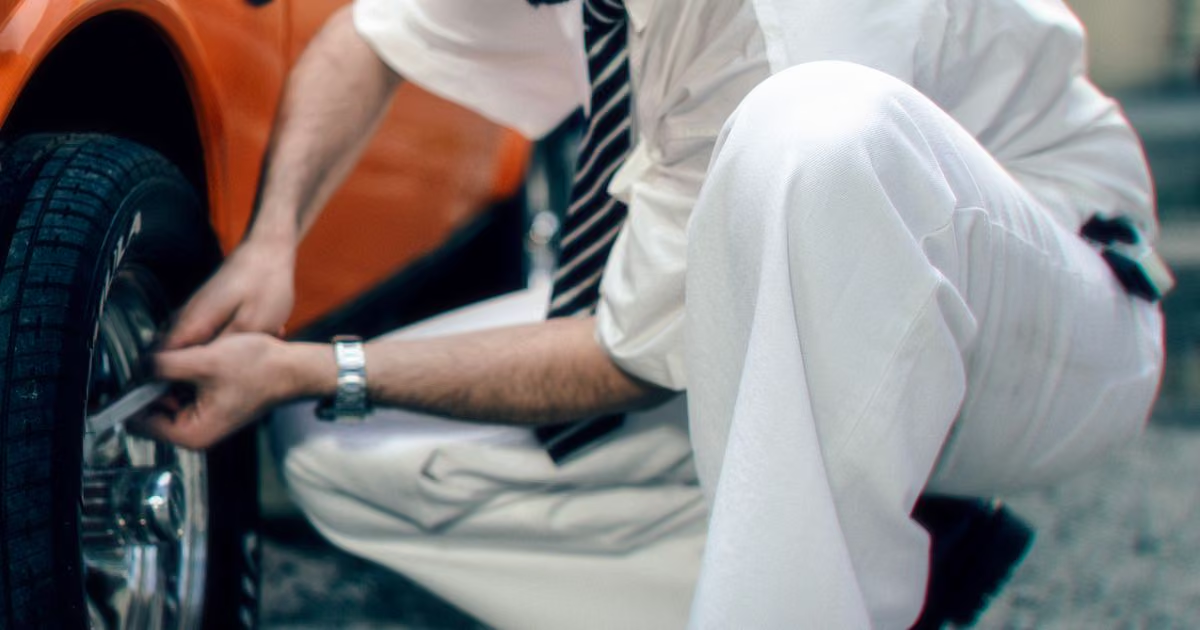
How this guide was checked: written by Abed Jabbarkhel, founder of Fast Tyre and a director of Fast Tyres Ltd since April 2021 (Companies House). His vans replace burst tyres where the car is, once it is off the road. Every legal and technical fact above is linked to its source where it is stated. UK road statistics do not count blowouts separately, so the only figure given is the DfT count for defective tyres. Spotted something out of date? Tell us through our contact page. The diagram is Fast Tyre's own. Photo: Artem Balashevsky on Pexels, not one of our jobs.
Frequently asked questions
You hear a bang, often followed by flapping or thumping, and the car pulls towards the side of the failed tyre. In practice, a front blowout usually drags the steering and a rear one makes the back of the car sway. Grip the wheel with both hands, keep straight, ease off the accelerator without braking hard, and let the car roll to a stop before steering gently to the side.
Keep control first: grip, straight, ease off. Then leave at the next exit or services if you can, otherwise go left into an emergency area or onto the hard shoulder with hazards on. Get out on the side away from traffic, wait behind the safety barrier where there is one and call National Highways on 0300 123 5000. If you are stuck in a live lane, stay in with your belt on and call 999. Never change a wheel on the motorway.
Not hard. With one tyre gone, sudden braking pulls the car unevenly and can start a slide. The Highway Code says to grip the wheel firmly and let the car roll to a stop. If you need to brake, do it gently and in a straight line once the car is under control.
TyreSafe says an under-inflated tyre flexes more and builds up heat, which makes a blowout much more likely. Goodyear adds overloading, and Pirelli says a sidewall bulge from pothole or kerb damage can burst. Old, cracked rubber is another warning sign. No UK source ranks these causes.
No, only as far as you must to get out of danger. The tyre is squashed between the rim and the road, which spreads the damage, harms the wheel and makes the car hard to control. Driving on a tyre with a tear or exposed cord is also illegal, with a fine of up to £2,500 and three points per tyre.
No. The BS AU 159 repair standard only allows repairs in the central tread and rules out sidewall damage, separation, bead damage and damage from running flat, which a blowout usually causes. A burst tyre is replaced, and the wheel should be checked before the new tyre goes on.
No. A puncture is a hole, often from a nail or screw, and is often repairable if it is in the central tread. A burst or blowout is the tyre structure tearing open, and it always means a new tyre.
Not from the heat of the day alone. TyreSafe says a correctly inflated tyre has a large safety margin and will not burst in a heatwave. The risk is a tyre that is already soft or overloaded, which heats up from flexing on a long, fast run.