
Key takeaways
- On a normal tyre, drive only as far as you must to get somewhere safe, slowly with hazards on. The Highway Code says to stop as soon as it is safe to do so.
- Run-flat tyres (marked RF) are the exception: drive gently at no more than 50mph and treat 50 miles as the most you cover, unless your handbook gives a different figure. TyreSafe says RF tyres are built to run without air for at least that far.
- Driving on a flat crushes the sidewall and liner, and under-inflation damage is one of the things that rules out a BS AU 159 repair. The drive to the garage is usually what costs you the tyre.
- On a motorway, move left and stop on the hard shoulder or in an emergency area. Get out on the side away from traffic and wait behind the barrier. Call National Highways on 0300 123 5000, or 999 if you are stuck in a live lane. Then call your breakdown provider to recover the car.
Can you drive with a flat tyre? On a normal tyre, no. Drive only as far as you must to stop somewhere safe. Go at a crawl with the hazard lights on, then leave the car where it is. Run-flat tyres are the exception: no more than 50mph and normally no more than 50 miles, unless your handbook gives a different figure.
The rest of this guide covers how far is too far in each situation, what a flat does to the tyre and wheel, what to do in the next ten minutes, what the law says, and how to get it sorted without moving the car again.
Why you should only drive far enough to reach safety
The Highway Code, Annex 6 puts it in one line: "If you have a flat tyre, stop as soon as it is safe to do so." It then says to change the tyre only if you can do it without putting yourself or anyone else at risk, and otherwise to call for help.
The reason is mechanical. A tyre carries the car on its air, not its rubber. With the air gone, the sidewall folds under the load and gets pinched between the rim and the road on every turn of the wheel. The steering goes heavy, the car pulls towards the flat corner, and the tyre has lost most of its grip, so braking and cornering both get worse.
So in practice: if you are on a busy road with nowhere to stop, rolling slowly to the next lay-by, side street or car park is the right call, because you matter more than the tyre. If you are already parked somewhere safe, on a driveway or at the kerb outside work, do not move the car at all.
How far can you drive with a flat tyre?
There is no single safe distance, because "flat" covers several different situations. This is how they compare.
| Your situation | How far | What it usually means |
|---|---|---|
| Normal tyre, fully flat | Only to the nearest safe place, at walking pace | Expect a new tyre; the wheel needs checking |
| Normal tyre, soft but holding its shape | A short, slow trip once inflated, if it holds | Probably a slow puncture; get it inspected |
| Run-flat (RF) with the warning on | Up to 50 miles at no more than 50mph (handbook overrides) | Plan on a replacement |
| Space saver fitted | Usually no faster than 50mph and no more than 50 miles; check the label | A stopgap until a proper tyre goes back on |
The run-flat figure is where a lot of confusion starts. It comes from TyreSafe's run-flat guidance, which also says the car must have a working tyre pressure monitoring system. It does not apply to an ordinary tyre. Pages that quote it as a general limit for any flat are mixing the two up.
If you are not sure what you have, look for "RF" (or a maker's run-flat mark) in the size writing on the sidewall, and read more in our guide to how run-flat tyres work.
Space savers have their own limits. TyreSafe says you are usually only permitted 50mph on one, recommends no more than 50 miles, and advises avoiding dual carriageways and motorways where you can. The sticker on the wheel or the handbook gives your car's figure.
Can I drive 10 minutes, a mile or 500 metres on a flat?
On a normal tyre that is fully flat, no: not for ten minutes and not for a mile. Ten minutes at town speeds is roughly a couple of miles. No source puts an exact distance on it. But a tyre driven fully flat for a mile often has its inner wall damaged, and TyreSafe lists under-inflation damage and liner damage among the things that rule out a repair. The tyre you hoped to save by driving to the garage is the one you destroy on the way.
Five hundred metres is a different question. If those few hundred metres are what it takes to get off a busy road and into a side street, do it, slowly, with hazards on. If you are already somewhere safe, there is no reason to move.
A soft tyre is a different case again. TyreSafe's puncture guide accepts that in some cases you may be able to drive a short distance with a punctured tyre, "only at low speeds and for the minimum distance needed to reach a garage or safe location". If you pump it up and it holds its pressure for a few minutes, you are looking at a slow puncture, not a flat.
What driving on a flat tyre does
- The tyre usually becomes scrap. The folded sidewall overheats and the inner liner gets ground into rubber dust. TyreSafe lists "damage caused by under or over inflation", liner deterioration and damage to the casing or bead among the things that rule out a repair to British Standard BS AU 159. That is why a small nail in the tread can still mean a new tyre, as our guide to which punctures can be repaired explains.
- The wheel takes the hits. With no air holding it up, the rim lands on the road. Alloys bend, crack and scrape, and a bent rim may not seal a new tyre properly.
- The sensor and the bead suffer. The pressure sensor inside the wheel can be crushed, and the tyre bead can be pushed off its seat, at which point you are steering on metal.
- Control goes. TyreSafe notes that a puncture makes the car drift or pull and changes how the steering and cornering feel. A flat front tyre drags the steering; a flat rear makes the back of the car wander under braking and in bends.
Run-flats are not immune. TyreSafe says driving on a deflated run-flat puts the structure under high stress that can make it "unsuitable and unsafe to repair", and several associations do not recommend repairing run-flats at all.
Flat tyre: what to do, step by step
- As it goes down: do not brake hard or swerve. The Highway Code's advice for a burst tyre is to grip the wheel firmly and let the car roll to a stop at the side of the road. Come off the accelerator and correct the pull gently.
- Choose where to stop: indicate early and aim for flat, firm ground away from traffic, such as a car park, lay-by, wide side street or driveway. Avoid bends, the brow of a hill and soft verges, which let a jack sink.
- Make yourself visible: hazard lights on, handbrake on, car in gear or Park. Put on a hi-vis vest if you carry one. On an ordinary road, rule 276 says a warning triangle goes at least 45 metres behind the car on the same side of the road; never use one on a motorway.
- Get everyone out on the side away from traffic and stand well back from the car.
- Look before you decide: a nail or screw in the tread, a cut or bulge in the sidewall, or a valve that hisses all tell you different things. Read the tyre size off the sidewall (for example 205/55 R16) and take a photo of it.
- Pick your fix: a usable spare, the jack and tools, the locking wheel nut key and a safe spot mean you can change the wheel yourself. A small hole in the tread and a sealant kit can get you moving slowly, as our tyre repair kit guide explains. Anything else, or any doubt, means calling someone out.
And a few things not to do: do not keep driving to find a garage, do not jack the car on a slope or soft ground, do not pull a nail out of the tread (it is often what is slowing the leak), and do not keep topping up a tyre that keeps going down.
Flat tyre and no spare: what now?
Many newer cars carry an inflator and a bottle of sealant instead of a spare. TyreSafe notes that many modern vehicles are no longer supplied with a space saver, to save weight and cost and improve efficiency. Whatever you drive (petrol, diesel, hybrid or electric), lift the boot floor and check the handbook before you assume there is a spare.
A kit is worth trying only for a small puncture in the main tread. TyreSafe says not to use one if the rim is damaged, the tyre has been deflated for a period of time, the hole is larger than 4mm, or the damage is outside the main tread area, and it calls kits "always only a short-term measure". A tyre that has already been driven flat fails the second test, so a kit is not the answer there.
With no spare and no suitable kit, the tyre has to come to the car. Our guide to what to do with no spare tyre goes through the options.
A flat on a motorway or fast road
On a fast road the tyre stops mattering. Highway Code rule 277 sets out the order:
- Leave the carriageway at the next exit or pull into a service area if possible.
- If you cannot, move into the left lane.
- Get into an emergency area or onto the hard shoulder if you can.
- Get out by the side furthest from traffic and wait behind the safety barrier where there is one.
- If you cannot get out safely, keep your seat belt fastened and the hazard lights on, stay in the vehicle and call 999 straight away.
The rule is explicit that you should not attempt repairs and should not put a warning triangle on the carriageway.
From behind the barrier, use the free emergency phone or, as National Highways advises, call them on 0300 123 5000, or 999 if there is an immediate risk to life.
Then contact your breakdown provider or a recovery service to move the car off the motorway, as rule 277 advises. We never work on a live carriageway, a hard shoulder or a slip road, and you should not try to either. Once the car has been recovered to a service area, off the motorway at a junction, or home, we can fit the tyre there.
Our guide to a flat on a smart motorway with no hard shoulder covers emergency areas, and if getting out of the car is difficult for you, read what to do when you cannot easily leave the car.
Is it illegal to drive on a flat tyre?
It can be. Regulation 27(1)(b) of the Road Vehicles (Construction and Use) Regulations 1986 covers tyre inflation. It says a vehicle must not be used on a road with a tyre that "is not so inflated as to make it fit for the use" it is being put to. A flat tyre plainly is not. Using a vehicle with defective tyres carries the endorsement code CU30 and 3 penalty points, according to GOV.UK.
No law names a distance. Moving the car a short way to get it out of danger is what the Highway Code asks you to do; carrying on with your journey on a flat is using a vehicle with a defective tyre.
Does a flat tyre always mean a puncture?
No. Plenty of tyres go flat with nothing stuck in the tread. TyreSafe's puncture guide points out that potholes and kerbs can damage the sidewall or the wheel rim, and that "sometimes, your tyre valve is the culprit". From the fitter's side, the other usual suspects are corrosion where the tyre seals against an alloy rim, a wheel cracked by a pothole, and a failing seal on a tyre pressure sensor. A perished or loose valve is a quick job to replace.
A tyre that reads a little low on a cold morning is not flat at all. As with any gas, the air in a tyre loses a little pressure as it cools, so all four tyres can read lower first thing and recover as the day warms. A tyre that is visibly squashed at the bottom is a real problem.
What a fitter checks before saying repair or replace
Whether the tyre can be saved is decided with the tyre off the wheel, not by looking at it on the car. TyreSafe's summary of BS AU 159 says permanent repairs can only be done after removing the tyre so it can be inspected inside as well as out. A fitter checks:
- Where the hole is. TyreSafe says tyre repairs "can only be carried out on the central ¾ of the tyre". A nail near the shoulder or in the sidewall is outside that area and means a new tyre.
- The inside of the tyre. A tyre that has been run flat often shows a ring of wear or rubber dust on the inner sidewall. If the liner is damaged, it cannot be repaired, however small the hole.
- The bead and casing. A bead that has been pushed off its seat or torn, or any sign the structure has separated, rules out a repair.
- The wheel. The rim is checked for bends, cracks and corrosion where the tyre seals, because a new tyre on a damaged rim can leak again.
- The valve and sensor. A perished valve or a damaged pressure sensor can be the whole cause of the flat, and both are checked before the tyre goes back on.
If everything passes, the puncture is repaired to BS AU 159 on the spot; if not, a new tyre goes on in the same visit. Our puncture repair page sets out how that works.
Need someone to come to you?
Once the car is somewhere safe, the best thing you can do is leave it there and have the tyre brought to it. We work 24 hours a day, 365 days a year, including bank holidays. We typically arrive within 30 to 60 minutes anywhere we cover across London and the surrounding counties, and on site the job takes 20 to 30 minutes. If the tyre can be repaired, we repair it to BS AU 159; if not, we fit a new tyre from the van the same day, and take the old one away for licensed recycling. There is no out-of-hours surcharge at night, at weekends or on bank holidays.
When you call, these details get the right tyre on the van first time:
- Where the car is: a postcode, street name or landmark, and whether it is on a driveway, in a car park or at the kerb.
- The tyre size from the sidewall (for example 205/55 R16 91V), and whether it says RF or run-flat.
- The car: make, model and registration.
- Whether you have the locking wheel nut key. If it is lost, say so, as we can remove locking nuts without one.
- What you can see: a nail in the tread, a cut in the sidewall, a damaged wheel, or nothing at all.
- Whether you already have a tyre. We fit tyres you have bought yourself.
See how our flat tyre repair service works near you, or for night-time and roadside call-outs away from fast roads, our 24/7 emergency tyre call-out.
Do not drive on it to reach a garage. Once the car is off any fast road, we come to where it is, day or night, and repair or replace the tyre there. Typically 30 to 60 minutes to reach you.
Sources
Checked on 2 October 2026. Legal and safety points in this guide come from these primary and industry sources; the fitter's checks describe how the job is done.
- The Highway Code, Annex 6: vehicle maintenance, safety and security (GOV.UK)
- The Highway Code, rules 274 to 287: breakdowns and incidents (GOV.UK)
- Driving on motorways: what to do if you break down (National Highways)
- Road Vehicles (Construction and Use) Regulations 1986, regulation 27 (legislation.gov.uk)
- Penalty points: endorsement codes (GOV.UK)
- What are run flat tyres (TyreSafe)
- The complete guide to punctures and repairs (TyreSafe)
- Emergency puncture repair kits (TyreSafe)
- Space saver (TyreSafe)
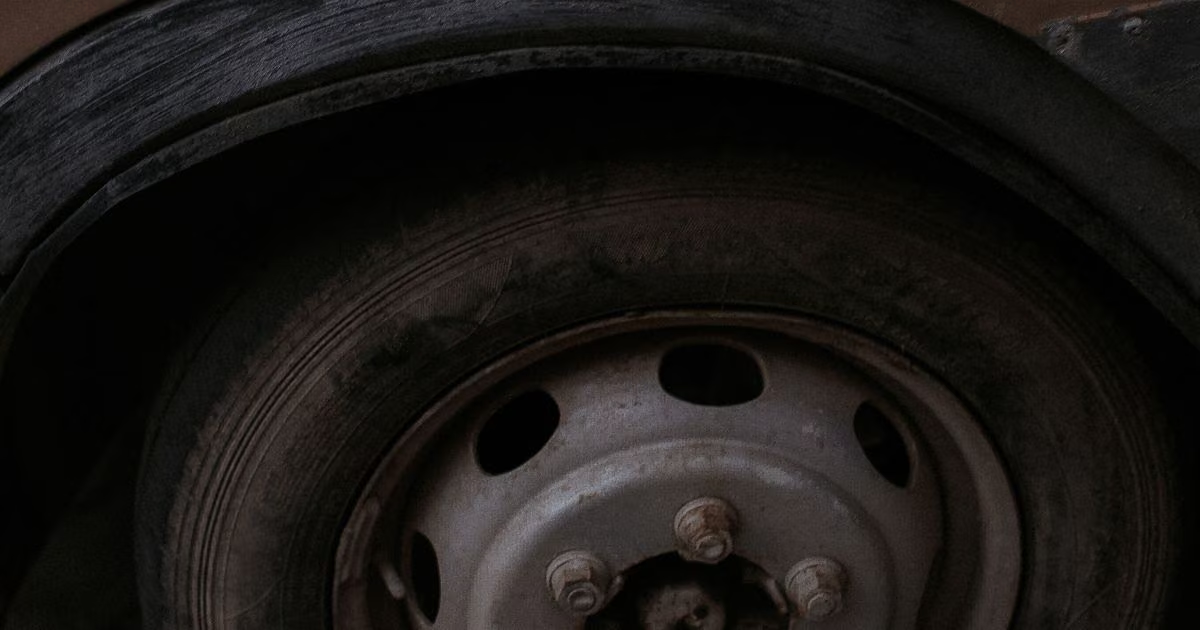
Photo: Artem Balashevsky on Pexels
Frequently asked questions
On a normal tyre, only until you reach the nearest safe place to stop, as the Highway Code says to stop as soon as it is safe to do so. Run-flat tyres (marked RF) are the exception: no more than 50mph and normally no more than 50 miles, unless your handbook gives a different figure. On a space saver it is usually no faster than 50mph and no more than 50 miles; check the label on the wheel.
Not on a normal tyre that is fully flat. The drive to the garage is usually what turns a small repairable puncture into a new tyre and sometimes a damaged rim. TyreSafe accepts that in some cases a short, low-speed trip to a garage or safe place may be possible; in practice that means a tyre that is only soft and holds air once pumped up. Otherwise, stop somewhere safe and have a mobile fitter come to the car.
No. TyreSafe describes puncture repair kits as always only a short-term measure, and says not to use one if the tyre has been deflated for a period, the hole is over 4mm, it is outside the main tread or the rim is damaged. Follow the speed and distance limits on the kit and get the tyre inspected as soon as you can.
If you have breakdown cover, check your policy for what it says about tyres and spare wheels, as terms vary between providers and we cannot speak for them. The other option is a mobile tyre fitter, who brings the tyre to the car and repairs or replaces it there.