
Key takeaways
- Station car parks are usually barrier-controlled and unstaffed in the evening, so check how you get out before you need to.
- A car left overnight in a daily-rate car park keeps charging. Note the time and photograph the tyre.
- The car sat still all day, which is exactly when a slow puncture picked up that morning finally empties.
- Level ground and lighting make it a reasonable place to change a wheel, if you have a usable spare.
The station car park version of a flat tyre has its own particular timing. You left the car at seven in the morning, it has sat undisturbed for twelve hours, and you come back to it in the dark at the end of a working day with a train home no longer an option because you are already home, or as close as the car park.
It is a more manageable situation than it feels, and the first thing to establish is not the tyre.
Can you get out of the car park at all?
Check the barrier arrangement before anything else. Many station car parks are barrier-controlled with automatic number plate recognition or ticket exit, unstaffed after the ticket office closes, and operated on a daily rate that keeps accruing while your car stays put. Whether a fitting van can get in, and whether you can get out afterwards, is worth knowing before you spend an hour on the tyre.
The things to look for while you still have phone battery:
- Is the exit barrier automatic, ticket-operated, or staffed? Unstaffed sites usually publish a helpline number on the barrier itself.
- Is there a height restriction at the entrance? Most surface station car parks have none, but multi-storey ones at larger stations do.
- What is the overnight rate, and does the daily charge roll over at midnight?
- Is the car park operated by the rail company or a private operator? The signage will say, and it determines who you talk to.
Why did it go flat while it was parked?
Because standing still is when a slow puncture does its work. Something picked up on the morning drive can seal well enough to hold pressure at speed and then leak steadily once the car is stationary and the weight is settled on one part of the tyre. Twelve hours is plenty of time for a leak that was invisible at eight in the morning.
The usual causes are the ordinary ones, and the pattern of what you find narrows it quickly:
| What you find | Likely cause | Repairable? |
|---|---|---|
| A nail or screw in the tread | Picked up on the drive in | Usually, if it is in the central three-quarters |
| Nothing visible, tyre flat | Valve failure or bead leak | Valve yes, bead usually yes |
| Bulge or cut in the sidewall | Kerbing, often on the way in | No. Sidewalls cannot be repaired |
| All four low, cold night | Temperature, not a puncture | Nothing to repair. Inflate and recheck |
| Valve cap missing, tyre flat | Possible interference with the valve core | Usually, but report it to the operator |
If it is the fourth row, and every tyre reads a little low after a cold night, that is air contracting rather than anything wrong. The same effect catches people out after longer stays, which the airport car park guide goes into.
Changing a wheel in a station car park
It is one of the more workable places, provided you have a usable spare. The ground is level and made up, there is normally lighting, and the traffic that remains in the evening is moving at walking pace. The two constraints are darkness and the tightness of the bays, and both are manageable.
- Use the car's own lights or a phone torch propped where it shines on the wheel rather than in your eyes.
- Chock the diagonally opposite wheel. Station car parks are graded for drainage like any other.
- Get the boot cleared first; the jack, brace and locking wheel nut key almost always live under the floor.
- If the bay beside you is empty at that hour, use the space rather than working in a metre-wide gap.
If there is no spare
Most cars built in the last decade carry a sealant kit rather than a wheel, and a sealant kit only addresses small punctures in the tread. Against a sidewall cut, a failed valve or a tyre that has been driven on flat it does nothing. At that point the tyre has to come to the car, and a station car park is a straightforward place for that to happen.
If it keeps happening on the commute
A second or third flat in a few months is a pattern, not luck, and it usually has a findable cause. Commuting is unusually hard on tyres: the same route every day, the same junctions, the same kerb on the same turn, and long stationary periods at both ends that let any slow leak declare itself.
Worth checking if this is not the first time:
- The route. One bad stretch of road hit twice a day does far more damage than occasional motorway miles.
- Pressures. Persistent underinflation overheats the sidewall and makes a puncture more likely, and it is the most common cause of repeat problems.
- Wear pattern. Uneven wear points at alignment, which will keep eating whatever is fitted next.
- Valve age. Valves perish, and a set fitted years ago will fail at roughly the same time.
Reading the wear pattern is the quickest way to tell a road problem from a car problem.
Waiting safely in an empty car park
Wait where there is light and, if you can, where there are still people. Station car parks empty out quickly after the evening peak, and the far corners are frequently the darkest part of the site. None of this is about the tyre; it is simply that a long wait alone in an unlit car park is worth avoiding when the alternative costs nothing.
- Move to a bay under a light if the car will roll that far, or wait on the platform side where the station is still lit.
- Tell someone where you are, by station name and car park, and roughly how long you expect to be.
- Keep the phone charged. If it is low, the station will usually have a socket.
- If the station is closing and you would rather not stay, leaving the car and returning in daylight is a legitimate choice.
Getting home tonight
The realistic options are the spare, a tyre brought to the car, or leaving it and coming back. Leaving it is more viable here than almost anywhere else, because you are at a station with trains and probably a route home that does not involve the car at all, which is a genuine advantage over being stuck in a supermarket car park.
What makes that decision is usually the parking charge and whether you need the car in the morning. If you do, having the tyre replaced where it stands is the shorter path. If you do not, and the daily rate is modest, coming back in daylight with the key and a clear head is a perfectly reasonable choice, and nobody should talk you out of it.
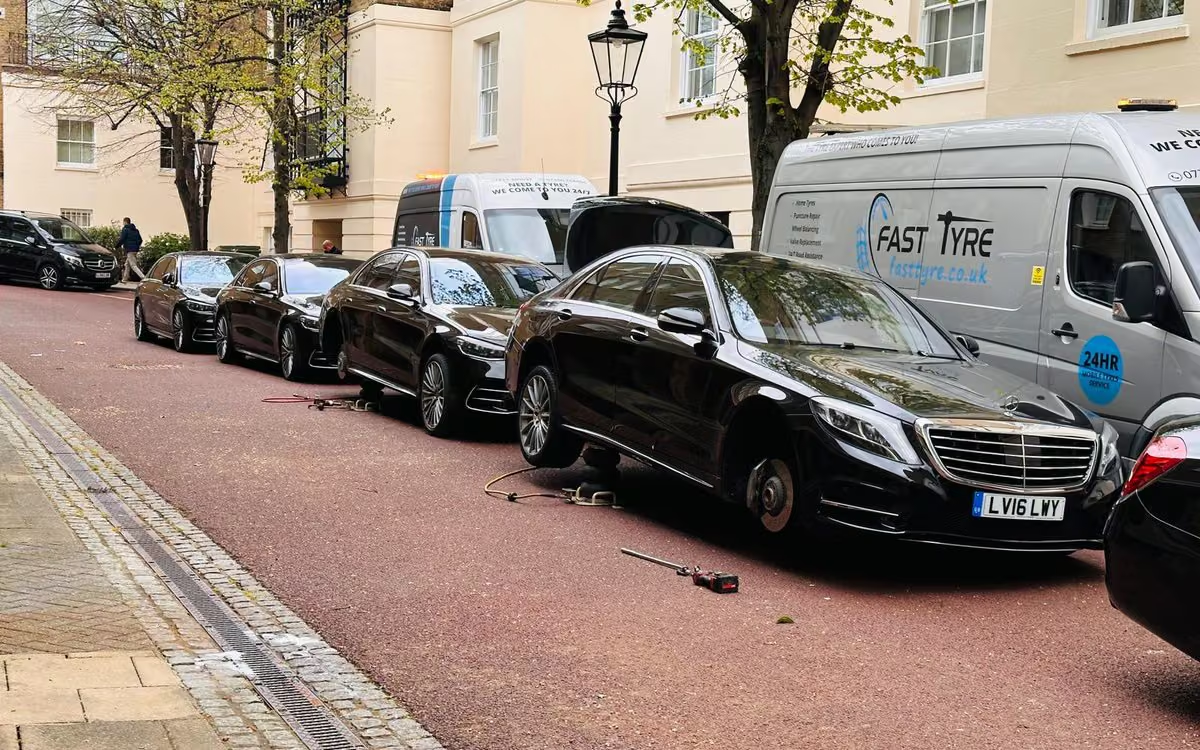
We bring the tyre, the fitting machine and the balancer to the car park so you drive home rather than leave the car overnight. Give us the station, the car park postcode and the size off the sidewall. Typically 30 to 60 minutes across London and the nearer Home Counties, longer further out, and you get a real arrival time on the call.
If the tyre is holding air and you are weighing up the drive home, this covers where the line sits. For the diagnosis itself, see slow punctures, and 24-hour emergency callout explains how evenings and nights work.
Frequently asked questions
Ring the helpline number printed on the barrier or the payment machine and tell them the car has broken down, before you leave rather than afterwards. Unstaffed sites still have an operator, and reporting it at the time makes any charge much easier to discuss.
Usually yes, and surface station car parks are easy to work in: level, lit and quiet in the evening. Give the station name and the car park postcode, plus the tyre size from the sidewall, and check whether there is a height barrier at the entrance.
A slow leak empties fastest when the wheel is still and the weight sits on one spot. Something picked up on the morning drive can hold pressure at speed and then let go over twelve hours, which is why so many flats are found on the way back to the car.
Probably, since most station car parks run on a daily rate that rolls over. Photograph the tyre with the bay or a sign in shot, note the time and report it to the operator. Whether they waive it is their decision, but evidence taken at the time helps.
It is a reasonable option and you are in one of the few places where it is easy. Weigh the overnight parking charge against whether you need the car in the morning. If you do need it, having a tyre brought to the car is the shorter route.